
Key takeaways
- Eastern subterranean colonies can forage up to 150 feet, and Formosan colonies up to 100 meters, so one colony can reach several South Florida lots.
- Drywood termites spread by swarming and in infested furniture and wood, not through the soil.
- Outdoor termite swarms mean an active colony is in the area, even if your home is not infested yet.
- A liquid barrier next door protects that house but may not eliminate the colony, which can keep foraging nearby.
- A neighbor's infestation is a reason to inspect your own home, not proof that you have termites.
In this article
- How Far Can Termites Travel Underground?
- How Drywood Termites Spread From House to House
- Swarms: The Clearest Neighborhood Warning Sign
- Common Bridges Between Neighboring Properties
- Does a Neighbor’s Treatment Push Termites to Your House?
- What to Do If Your Neighbor Has Termites
- What a Professional Termite Inspection Looks For
- Frequently Asked Questions
Yes, your neighbor’s termites can spread to your home. Subterranean termite colonies forage underground far beyond a single lot, and winged swarmers from an infested house can fly to the homes around it and start new colonies. Termites do not recognize fences, lot lines or HOA boundaries.
That does not mean your home is already infested. It means your risk is higher than it was, and that the conditions on your own property now matter more. In South Florida neighborhoods, where homes sit close together and the soil stays warm and moist much of the year, a termite problem next door is one of the clearest early warnings you will get.
How Far Can Termites Travel Underground?
Subterranean termites live in the soil and send workers out through tunnels and mud tubes to find wood. Their foraging range is the main reason one infested property can affect its neighbors. According to UF/IFAS, a colony of the native eastern subterranean termite may contain 100,000 to 1,000,000 termites and forage up to 150 feet for food. The invasive Formosan subterranean termite reaches even farther: UF/IFAS reports colonies foraging up to 100 meters in the field.
Source: UF/IFAS EDIS (IN369, IN278)
Distances like these can span several residential lots. A colony feeding on your neighbor’s fence, deck or landscape timbers may already have tunnels running under your yard, even if it has not found your house yet. Formosan and Asian subterranean termites, both common in Miami-Dade and Broward, also build carton nests in wall voids and hollow trees, which lets a colony settle in close to new food. For more on the eastern subterranean termite and its habits, see our species profile.
How Asian Subterranean Termites Move Through Neighborhoods
The Asian subterranean termite is a South Florida specialty, and it spreads through urban areas by swarming, foraging and, near the coast, on infested boats. Our article on how Asian subterranean termites spread through entire neighborhoods covers that pattern, and our guide to Asian subterranean termites in South Florida explains how to identify them.
How Drywood Termites Spread From House to House
Drywood termites work differently. They live entirely inside dry wood and never need contact with soil, so they do not tunnel from one yard to the next. They spread in two ways:
- Swarmers. Mature colonies release winged termites that fly to new wood. UF/IFAS notes that West Indian drywood termite swarmers leave on several mating flights from April to June, though flights can happen at any time of year. Like other swarmers, they are often drawn to lights, and they can enter through attic vents, gaps around windows and exposed wood.
- People moving wood. Because they need so little moisture, drywood termites travel easily in furniture, frames and other wooden items, which is how the West Indian drywood termite spread around the world, according to UF/IFAS.
A neighbor with an active drywood infestation is a source of swarmers for every house within flying range. Buying used furniture or salvaged wood from an infested home is another direct route. Our article on how drywood termites sneak into homes through furniture and wood trim explains what to check.
Need help with pests in South Florida?
Toro Pest Management has protected homes and businesses since 1969. Get a free inspection and $25 off your first service, backed by our 110% Satisfaction Guarantee: if the pests come back, so do we, at no extra cost.
Swarms: The Clearest Neighborhood Warning Sign
Swarms are when most homeowners first realize termites are nearby. The University of Georgia puts it simply: outdoor swarms are signs of an active colony in the area or yard, but they do not necessarily mean a structure is infested.
Indoor swarms are a different matter. UF/IFAS notes that subterranean swarms can occur indoors when a structure is infested, so winged termites coming out of walls or baseboards point to a colony in or right next to your home. If your neighbor mentions a swarm, or you find wings on your windowsills or under porch lights, note the date and time of day. Asian subterranean termites swarm at dusk or night from February to April, Formosan termites after sunset from April to June, and native subterranean termites on warm, sunny afternoons. Our guide to termite swarming in Florida covers each season.
Common Bridges Between Neighboring Properties
Termites expand along a path of food, moisture and cover. In tightly built neighborhoods, these features often connect one property to the next.
| Bridge | Why termites use it | What you can do |
|---|---|---|
| Wooden fences on the property line | Posts in soil are food and a pathway along the lot | Inspect posts at the soil line; use concrete footings when replacing |
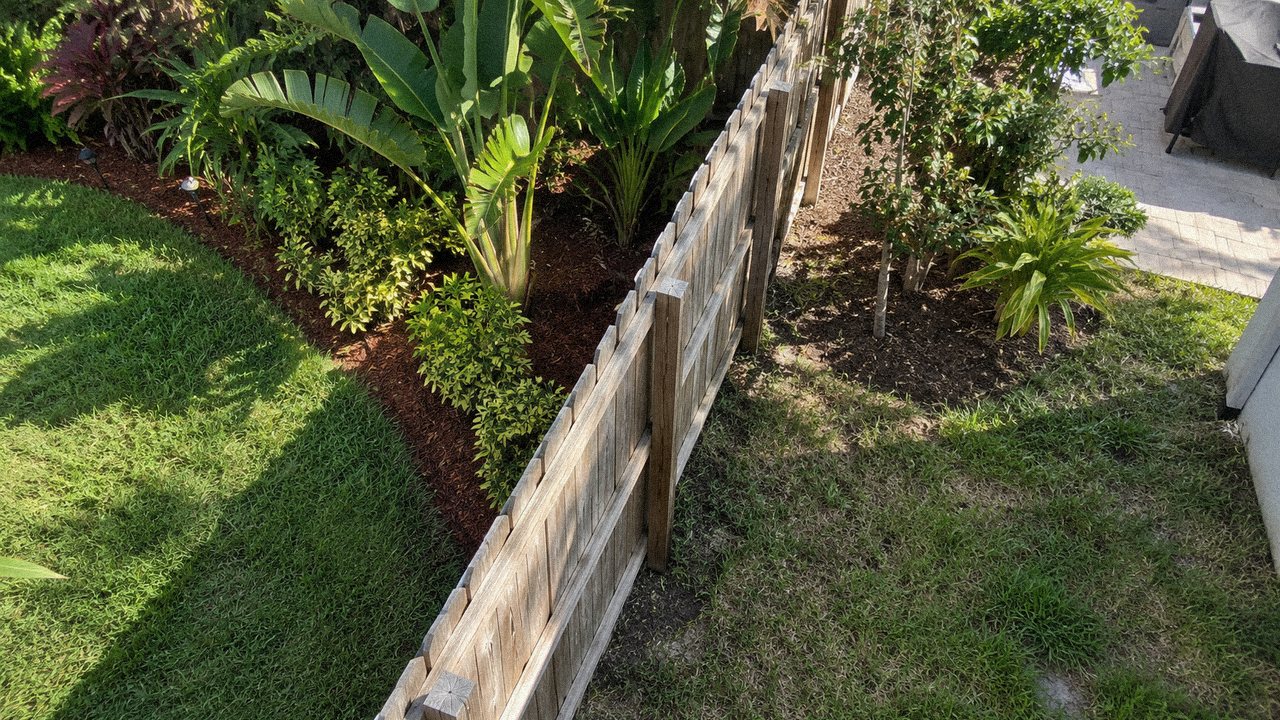
| Shared hedges and dense beds | Shade and irrigation keep soil moist | Keep plantings off the walls and sprinklers off the foundation |
| Thick mulch against the house | Holds moisture and hides mud tubes | Keep mulch under 2 inches, with a 6-inch inspection strip |
| Trees near both houses | Colonies can nest inside trunks | Have trees near the house inspected |
| Firewood, lumber and debris | Food in direct contact with soil | Store off the ground and away from walls |
| Railroad ties and salvaged timbers | Can carry live colonies onto a property | Avoid or inspect before using |
| Shared walls, roofs and attics | Connected framing in townhomes and condos | Coordinate inspections and treatment with the association |
UF/IFAS research on mulch shows that chipped mulch rarely carries live colonies; the bigger risk, it notes, is termites already established on your property, along with large pieces of infested wood such as railroad ties, which can spread invasive termites. That is exactly the situation a neighbor’s infestation creates.
Does a Neighbor’s Treatment Push Termites to Your House?
It depends on the treatment. Liquid termiticides applied around a foundation keep termites out of the treated zone, but UF/IFAS notes that colony activity in the surrounding area is unlikely to be eliminated. So a neighbor’s soil treatment protects their house while the colony may keep foraging nearby, including under your yard. Baits work differently: termites carry them back to the nest, and UF/IFAS notes that it takes about 3 months for all the workers in a Formosan colony to molt and die, after which the rest of the colony starves.
Tent fumigation kills drywood termites inside the tented home; it does not chase them next door. If a neighbor is tenting, the National Pesticide Information Center advises that neighbors keep pets and children away from the structure during fumigation and aeration.
What to Do If Your Neighbor Has Termites
- Ask what they found. The species, where the damage was and how it was treated tell you a lot about your own risk.
- Walk your perimeter. Look for mud tubes on the foundation, slab edges, garage walls and fence posts, and for wings on windowsills.
- Check your wood near the line. Probe fence posts, deck posts and wood steps at the soil line with a screwdriver.
- Fix moisture. Repair leaks, clean gutters, extend downspouts and aim sprinklers away from walls.
- Clear the foundation. Pull back mulch and plants so the bottom of the wall is visible.
- Schedule an inspection. Termites usually work out of sight, so a trained inspector is the only way to know for sure.
What a Professional Termite Inspection Looks For
A good inspection covers far more than the spots you can see from the yard. Inspectors check the foundation and slab edges, exterior walls, the garage, attic spaces, plumbing penetrations, areas with moisture problems, landscaping and any place where wood meets soil. They identify the species, because subterranean and drywood termites need different treatments. Our guide on what to expect during a termite inspection walks through the process step by step.
Toro’s termite control begins with a free inspection by a trained technician who identifies the species and checks how far any activity goes. For subterranean termites, Toro installs the Sentricon baiting system around the property, which is designed to eliminate the colony, including the queen, and the stations stay in place for year-round protection against new colonies moving in from nearby. Localized drywood colonies can be treated with TORO-GUARD, and tent fumigation is used when drywood termites have spread through the structure.

Contact Toro today
A free inspection & $25 off your first service
A trained Toro technician inspects your home or business, explains what was found and gives you a clear plan and quote, backed by our 110% Satisfaction Guarantee.
305-594-4767Frequently Asked Questions
If my neighbor tents their house, will the termites move to mine?
Should I tell my neighbors if I have termites?
Are townhomes and condos at higher risk from a neighbor's termites?
Can termites travel through tree roots?
How do I know if termites in my yard came from next door?
Sources
- Native Subterranean Termites: Reticulitermes flavipes, R. virginicus, R. hageni (EDIS IN369), UF/IFAS Extension
- Formosan Subterranean Termite, Coptotermes formosanus (EDIS IN278), UF/IFAS Extension
- West Indian Drywood Termite, Cryptotermes brevis (EDIS IN236), UF/IFAS Extension
- Subterranean Termites, University of Georgia Center for Urban Agriculture
- The Facts About Termites and Mulch (EDIS IN651), UF/IFAS Extension
- Structural Fumigation, National Pesticide Information Center
Educational content. This article is for general information about pests in South Florida and is not medical, legal or professional advice. If you have a bite, sting or allergic reaction, contact your doctor; in an emergency, call 911. Pest problems vary from home to home, so a licensed professional should inspect before treatment. When using any pesticide, always read and follow the product label.


