
Key takeaways
- Fire ants bite to hold on and then sting repeatedly; brush them off quickly instead of hosing them, which makes them grip harder.
- Seek emergency care right away for chest pain, trouble breathing, serious swelling, nausea, heavy sweating or slurred speech after stings.
- Pustules can last up to 10 days; keep them clean and do not let children pop or scratch them, since broken pustules can get infected.
- Very young, old, caged or injured pets are most at risk, and stings usually hit the ears, eyes, muzzle and belly.
- Keep pets off treated areas as the label directs and store fire ant baits where kids and pets cannot reach them.
In this article
- Why Children and Pets Get Stung More Often
- How to Spot Fire Ant Mounds Before Kids Play
- Outdoor Safety Rules for Children
- Keeping Pets Safe From Fire Ants
- First Aid for Fire Ant Stings
- When a Sting Needs Medical Attention
- Keeping Fire Ants Away From Play Areas and the House
- When to Call a Professional
- Frequently Asked Questions
The best way to protect children and pets from fire ants is to find and treat mounds before anyone plays near them, dress little feet for the yard, and know exactly what to do in the first minute after a sting. For most people a few stings are painful but not dangerous; the real risks are a child or pet who steps into a mound and gets dozens of stings, an allergic reaction, or pustules that get scratched open and infected.
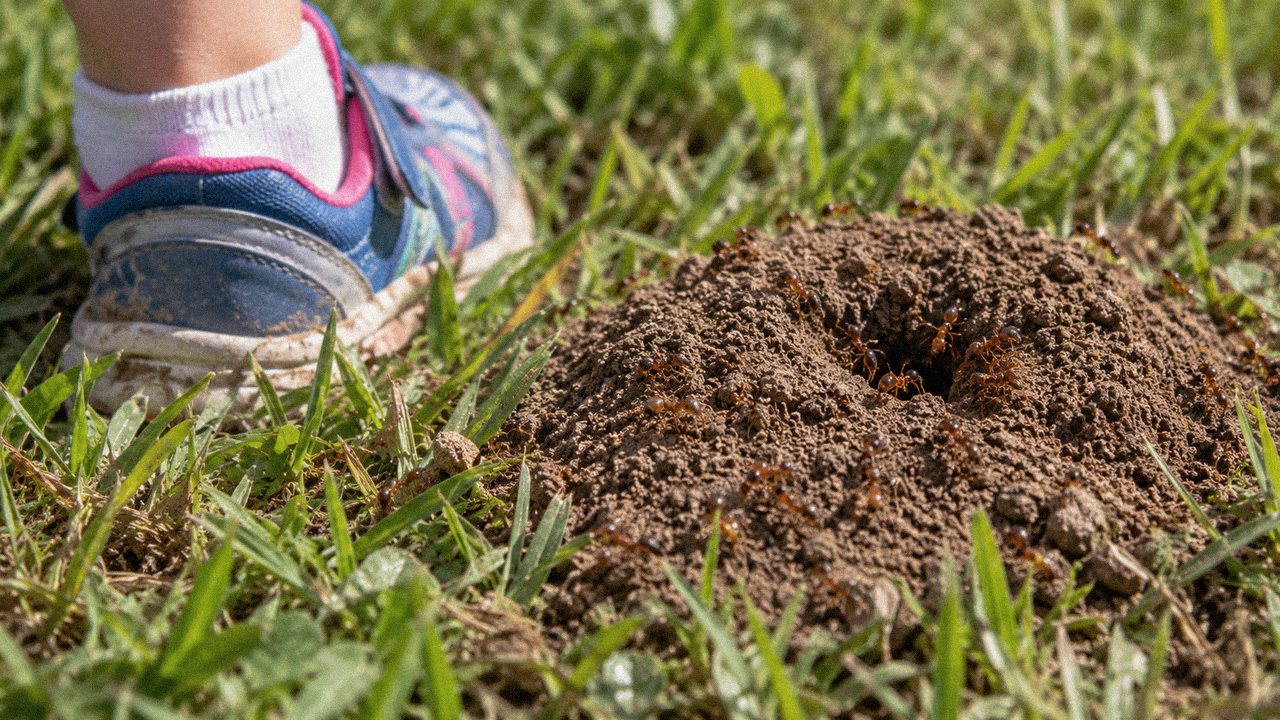
Fire ants are a year-round reality in South Florida. They nest in sunny lawns, playgrounds, sports fields and along driveways, and Florida’s sandy soil keeps many mounds so low that a toddler or a dog can be standing on one before anyone notices. This guide focuses on the people and animals who are most at risk and the steps that actually keep them safe.
Why Children and Pets Get Stung More Often
Fire ants defend their nest aggressively. When a mound is disturbed, workers pour out and run up any vertical surface, whether a grass blade, a sneaker or a leg, then bite to grip the skin and sting, often several times. UF/IFAS extension guidance notes that a disturbed mound can release hundreds of workers.
Kids and pets are in the danger zone for simple reasons:
- They are close to the ground. Children sit, crawl and kneel on the lawn; dogs sniff, dig and lie down.
- They do not recognize mounds. A flat patch of loose soil does not look dangerous.
- They react slowly. A toddler may freeze or cry instead of moving away, and a leashed dog may be held in place.
- Smaller bodies, more stings. The same number of stings covers more of a small child or a small pet.
To understand why the sting burns and blisters the way it does, read our Fire Ants 101 guide.
How to Spot Fire Ant Mounds Before Kids Play
Teaching children to recognize a mound is one of the best defenses, and UF/IFAS guidance specifically recommends teaching children and visitors to watch for mounds. Look for:
- Domes or patches of loose, crumbly soil in sunny spots, often with no opening on top
- Mounds along sidewalks, driveway edges, fence lines and the base of trees
- Soil coming up between pavers on the pool deck or patio
- New mounds a day or two after heavy rain
- Reddish-brown ants of different sizes swarming when the soil is touched
You can find detailed identification photos and facts on our red imported fire ant page.
Need help with pests in South Florida?
Toro Pest Management has protected homes and businesses since 1969. Get a free inspection and $25 off your first service, backed by our 110% Satisfaction Guarantee: if the pests come back, so do we, at no extra cost.
Outdoor Safety Rules for Children
Simple habits prevent most stings:
- Shoes on in the yard. Closed-toe shoes, not sandals or bare feet, especially on grass and near garden beds.
- Long pants for yard work and rough play in grassy or wooded areas. UF/IFAS guidance suggests tucking pant legs into socks.
- Check before sitting. Look at the ground before spreading a blanket or sitting on the lawn.
- Check items lifted from the ground. The CDC advises checking items before lifting them off the ground because fire ants may cover them, and toys or balls left on the lawn are a common example.
- Teach the rule: move away first. Children should step away from the mound and call an adult rather than stomping or kicking it.
Insect repellent on clothing may discourage foraging ants, but UF/IFAS notes it will not stop ants from swarming out of a disturbed mound, so it is not a substitute for checking the ground.
Keeping Pets Safe From Fire Ants
Texas A&M AgriLife Extension reports that fire ants can sting and occasionally kill small animals, and that veterinarians treat small animals and pets for fire ant injuries more often than other animals. The animals most at risk are very young, old, caged or those that have difficulty moving. Pets with open sores, hot spots or bandages are more vulnerable and more likely to have a severe reaction.
- Watch the food bowl. Fire ants are drawn to greasy, oily foods, especially cat and dog food, according to the National Pesticide Information Center. Feed indoors or pick up bowls after meals.
- Check the dog run and favorite resting spots for mounds every week during the rainy season.
- Keep puppies, older dogs and recovering pets away from untreated lawn areas.
- Do not tie or crate pets on the lawn where they cannot move away from ants.
- Check outdoor pens, hutches and chicken coops, since caged animals cannot escape.
First Aid for Fire Ant Stings
What you do in the first minute matters.
For Children and Adults
- Move away from the mound immediately.
- Brush the ants off briskly with a hand or cloth. The CDC notes fire ants attach to the skin with their jaws, so they do not simply fall off.
- Wash the area gently with soap and water.
- Apply a cold compress to ease swelling and burning.
- Ask a doctor or pharmacist about antihistamines or anti-itch products suitable for your child’s age, and follow the package directions; the CDC notes antihistamines may cause drowsiness.
- Do not break the pustules. UF/IFAS warns they can become infected if broken open.
For Pets
- Move your pet away from the ants as quickly as possible.
- Brush the ants off by hand, protecting yourself. Texas A&M AgriLife advises against spraying them off with a hose, because the ants hang on with their jaws and keep stinging.
- Check thin-haired areas such as the ears, eyes, muzzle and belly.
- Call your veterinarian, especially for many stings, stings near the eyes or any change in breathing or behavior. Do not give human medicine unless your vet tells you to.
When a Sting Needs Medical Attention
| What you see | What it usually means | What to do |
|---|---|---|
| Burning, red bumps at the sting sites | Normal local reaction | Wash, cool compress, watch |
| White pustules a day or two later | Normal venom reaction | Keep clean, do not pop, prevent scratching |
| Area becomes more red, warm, painful or drains | Possible infection | Call your doctor or veterinarian |
| Large swelling spreading beyond the stings | Strong local reaction | Call your doctor or veterinarian |
| Many stings on a small child or pet | Higher venom load | Call your doctor or veterinarian promptly |
| Chest pain, trouble breathing, serious swelling, slurred speech, nausea or heavy sweating | Possible severe allergic reaction | Emergency care immediately |
People who have reacted badly to insect stings before should see an allergist and carry any medication their doctor prescribes, as UF/IFAS extension guidance recommends.
Keeping Fire Ants Away From Play Areas and the House
Avoiding mounds only goes so far; reducing them is what keeps a yard usable. Fire ants usually nest outdoors, but they may forage indoors, especially in hot, dry summers, and they move to higher ground during floods. Our guide on how fire ants survive flood waters explains what to watch for during storm cleanup.
- Keep food sealed and clean up crumbs, spills and pet food promptly.
- Seal cracks and gaps around doors, slabs and plumbing.
- Trim plants away from the house, since branches act as bridges, as NPIC notes.
- Cover outdoor trash cans and empty them regularly.
- Coordinate with neighbors, because untreated yards keep supplying new colonies.
If you use any product yourself, read the whole label first. Texas A&M AgriLife advises removing pets during any application, sweeping up spilled bait, never leaving visible piles of bait on a mound and letting treated mounds dry before pets return. Store all pesticides where children and pets cannot reach them. Skip homemade remedies: club soda, grits and soap do not work, and gasoline is dangerous, according to UF/IFAS. Gardeners have their own challenges, covered in fire ants in your garden.
When to Call a Professional
Call a pest control professional when mounds keep appearing in play areas, when a child or pet has been stung more than once, when fire ants are indoors or around electrical equipment, or when you are not comfortable applying products around your family. NPIC notes that only a licensed pest control operator or an electrician should treat fire ants in or near electrical equipment.
Toro’s lawn spray service treats fire ants and other lawn insects with power lawn sprays and granules after a free inspection. Our specialists follow each product’s label, including when people and pets can return to treated areas, and plan around children, pets and play areas when you tell us about them. For pests inside the home, Toro’s residential pest control plan covers the interior and exterior every other month. Toro has protected South Florida families since 1969, and if the bugs come back, so will Toro, at no additional cost to you.

Contact Toro today
A free inspection & $25 off your first service
A trained Toro technician inspects your home or business, explains what was found and gives you a clear plan and quote, backed by our 110% Satisfaction Guarantee.
305-594-4767Frequently Asked Questions
How long do fire ant bites last on a child?
Should you pop fire ant blisters?
What do fire ant stings look like on a dog?
Are fire ant baits dangerous to pets?
Do fire ants come into the house and sting people in bed?
Sources
- Insects and Scorpions at Work, Centers for Disease Control and Prevention (NIOSH)
- Fire Ants, National Pesticide Information Center
- Fire Ant Control Methods around Pets, Texas A&M AgriLife Extension
- Managing Imported Fire Ants in Urban Areas, UF/IFAS Extension
- Fire Ants, UF/IFAS Gardening Solutions
Educational content. This article is for general information about pests in South Florida and is not medical, legal or professional advice. If you have a bite, sting or allergic reaction, contact your doctor; in an emergency, call 911. Pest problems vary from home to home, so a licensed professional should inspect before treatment. When using any pesticide, always read and follow the product label.


