
Key takeaways
- UF/IFAS lists citrus, oleander, milkweed, some crotons and some pentas among iguana-resistant plants, along with other toxic and tough, thick-leaved plants.
- Tough, thick-leaved plants and toxic plants are less favored overall, but no plant is completely iguana-proof.
- Iguanas favor hibiscus, roses, orchids, purple queen, Hong Kong orchid tree, garden greens, squash, melons, most fruits except citrus and tender new growth.
- Oleander is toxic to people and pets in all its parts, so plant it away from children, dogs and grazing animals.
- Protect the plants you value most with cages, screen or trunk guards; plant choice alone will not stop a hungry iguana.
In this article
Iguanas tend to leave alone citrus, oleander, milkweed and some crotons and pentas, along with tough, thick-leaved plants and toxic plants in general, according to UF/IFAS. Those are the safest bets when you replant a South Florida yard that iguanas visit.
Just do not expect miracles. “Resistant” means less favored, not immune. A UF/IFAS Extension agent in Broward County who wrote about his food forest in 2026 watched iguanas eat crotons, a plant on the resistant list, along with orchids, mango, coffee and much more. The smartest approach is to plant what iguanas dislike in the open and protect the plants they love.
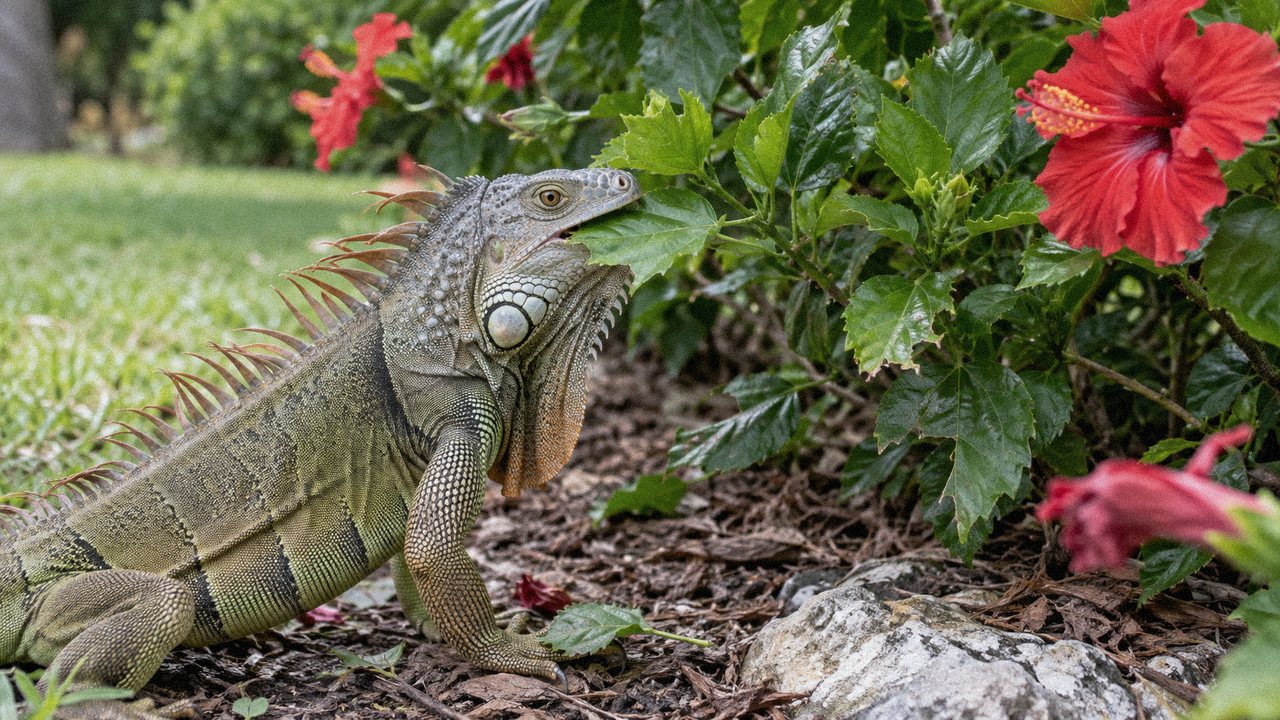
What Iguanas Eat in a South Florida Landscape
Green iguanas are mainly plant eaters. UF/IFAS explains that adults eat foliage, flowers and fruit, while juveniles eat more insects and other small animals. The FWC adds that iguanas are attracted to trees with foliage or flowers, most fruits except citrus and almost any vegetable.
Plants iguanas readily eat include:
- Ornamentals: hibiscus (including roselle), roses, orchids, impatiens, pink pentas, bougainvillea, nasturtiums, jasmine and firebush
- Landscape plants you might expect them to skip: purple queen (Setcreasea), the Hong Kong orchid tree and even turf grasses and weeds, all on the UF/IFAS list of preferred food plants
- Native plants: nickerbean, which the FWC notes is a host plant of the endangered Miami blue butterfly
- Palms: Washington fan palm, according to the FWC
- Vegetables: kale, broccoli, mustard, collards, sorrel, beets, lettuces, squash, melons, beans and pumpkins
- Fruit: berries, figs, mangos, tomatoes, bananas, lychees and passion fruit
- Almost anything tender: UF/IFAS lists “most tender new growth” and “most fruits and flowers”
Plants Iguanas Tend to Avoid
UF/IFAS Extension’s guide to iguanas in the South Florida landscape lists these plants as resistant. Here is what to know about each one.
1. Citrus
UF/IFAS states plainly that iguanas do not eat citrus, and the FWC agrees that citrus is the exception to their love of fruit. Lemons, limes, oranges and other citrus are the best fruit trees for an iguana-prone yard. Add a trunk guard if iguanas use the tree to climb.
2. Oleander
Oleander appears on both UF/IFAS’s resistant list and its repellent species list. It is also a practical South Florida shrub: UF/IFAS Gardening Solutions says it tolerates sea spray, drought and poor soils, which suits waterfront yards where iguanas are common.
The reason iguanas skip it is the same reason you should plant it carefully. UF/IFAS says all parts of oleander are poisonous to humans and animals, can cause vomiting, abdominal pain and heart symptoms if eaten, and that its sap can irritate skin. Never burn the clippings.
3. Milkweed
Milkweed is on both the UF/IFAS resistant list and the Gardening Solutions list of species iguanas dislike, so it is a good flowering option for open, sunny beds where iguanas roam.
4. Crotons
UF/IFAS lists “some crotons” as resistant, so treat them as “usually left alone,” not iguana-proof: the Broward food forest report lists crotons among the plants iguanas ate, so watch new plantings.
5. Pentas
The UF/IFAS fact sheet lists “some pentas” as resistant, but the same fact sheet puts pink pentas on its preferred food list, and UF/IFAS Gardening Solutions names pink pentas among the plants most attractive to iguanas. That split is a useful reminder that iguana preferences vary with the variety, the individual animal and how hungry it is. Plant pentas where you can watch them, and protect them if iguanas start sampling.
6. Tough, Thick-Leaved and Toxic Plants
UF/IFAS describes tough, thick-leaved plants and other toxic plants as resistant overall, and Gardening Solutions repeats that iguanas dislike tough, thick-leaved species. Leathery leaves are simply harder and less rewarding to eat than soft hibiscus leaves or ripe fruit.
Not Iguana-Resistant: Purple Queen and Hong Kong Orchid Tree
Some online lists of iguana-proof plants include purple queen and the Hong Kong orchid tree. The UF/IFAS fact sheet puts both on its list of preferred iguana food plants, next to hibiscus and orchids. If you already have them, protect young plants with cages or screen and watch for feeding damage; if you are replanting a yard iguanas visit, choose something from the resistant list instead.
Need help with pests in South Florida?
Toro Pest Management has protected homes and businesses since 1969. Get a free inspection and $25 off your first service, backed by our 110% Satisfaction Guarantee: if the pests come back, so do we, at no extra cost.
Quick Reference: Iguana-Resistant vs. Iguana-Favorite Plants
| Plant | Iguana interest | Notes |
|---|---|---|
| Citrus | Low | UF/IFAS says iguanas do not eat citrus |
| Oleander | Low | Toxic to people and pets; salt and drought tolerant |
| Milkweed | Low | On two UF/IFAS lists of avoided plants |
| Crotons | Low to moderate | “Some crotons” on the resistant list, but eaten in a 2026 Broward report |
| Pentas | Mixed | “Some pentas” resistant; pink pentas are a favorite |
| Purple queen | High | On the UF/IFAS preferred food list |
| Hong Kong orchid tree | High | On the UF/IFAS preferred food list |
| Tough, thick-leaved plants | Low | Less rewarding to eat |
| Hibiscus, roses, orchids | High | Protect with cages or screen |
| Garden greens, squash, melons | High | Grow in screened beds |
| Most fruit except citrus | High | Pick ripe fruit and clear fallen fruit |
| Tender new growth | High | Protect young plants until established |
Why No Plant Is Completely Iguana-Proof
Several factors push iguanas to eat plants they would normally skip:
- Hunger and competition. Where iguana numbers are high, the favorite plants disappear first and the rest get sampled next.
- Breeding season. The Broward Extension report notes that feeding intensified during the mating season; in Florida, iguanas typically lay eggs between March and August.
- Tender growth. New leaves and flowers are softer than mature foliage, even on resistant species.
- Plants still in pots. The same report describes iguanas eating plants before they were even in the ground.
That is why UF/IFAS pairs plant choice with protection: cages or screen enclosures for valuable plants, an L-shaped wire barrier to stop digging and sheet metal wrapped around trunks about 18 inches from the base to stop climbing.
Designing a Yard That Discourages Iguanas
- Never feed iguanas. UF/IFAS warns that feeding builds larger concentrations and draws rats and raccoons too.
- Pick fruit promptly and remove fallen fruit from mango, banana, fig and lychee trees.
- Thin dense thickets and remove rock and timber piles that give iguanas cover.
- Offer a nest decoy carefully. UF/IFAS suggests mulch or sand piles near seawalls to draw nesting away from the wall, but the Broward report notes iguanas nest in mulch piles, so keep any pile away from the house. Mulch against a foundation also has its own downside, explained in how landscaping choices attract termites.
- Keep up harassment with water spray and moving reflective objects; see what iguanas are afraid of.
For the complete prevention plan, including burrows and seawalls, read how to keep iguanas away from your yard. Iguanas also leave droppings on decks and docks that can carry Salmonella, covered in do iguanas carry disease.
When Plant Changes Are Not Enough
If iguanas are stripping your landscape despite new plants and barriers, or digging under seawalls and sidewalks, the animals already living on the property usually need to be removed. Green iguanas are invasive in Florida and protected only by anti-cruelty law, and the FWC encourages landowners to remove them; captured iguanas cannot be released elsewhere in Florida.
In Miami-Dade, Toro’s wildlife control service starts with a free inspection to find where iguanas feed, bask and burrow, then traps and removes them by humane methods allowed under FWC rules. Learn more about the animal itself in our green iguana profile. Toro has served South Florida since 1969 and responds within 24 hours, guaranteed.

Contact Toro today
A free inspection & $25 off your first service
A trained Toro technician inspects your home or business, explains what was found and gives you a clear plan and quote, backed by our 110% Satisfaction Guarantee.
305-594-4767Frequently Asked Questions
Do iguanas eat citrus trees?
Do iguanas eat hibiscus?
Do iguanas eat palm trees?
Are plants that iguanas avoid safe for my pets?
What attracts iguanas to my yard besides plants?
Sources
- Dealing with Iguanas in the South Florida Landscape, UF/IFAS Extension
- Iguanas as Garden Pests, UF/IFAS Gardening Solutions
- Green Iguana, Florida Fish and Wildlife Conservation Commission
- From Wasteland to Wonderland: A Food Forest Journey Part 4 – Iguanas: A Challenge, A Question, A Lesson., UF/IFAS Extension Broward County
- Common Poisonous Landscape Plant Species in Florida, UF/IFAS Extension
- Oleander, UF/IFAS Gardening Solutions
Educational content. This article is for general information about pests in South Florida and is not medical, legal or professional advice. If you have a bite, sting or allergic reaction, contact your doctor; in an emergency, call 911. Pest problems vary from home to home, so a licensed professional should inspect before treatment. When using any pesticide, always read and follow the product label.


