
Key takeaways
- Boxelder bugs feed mainly on the seeds of female boxelder trees and only rarely bite people. Indoors they do not eat food or clothing or breed.
- In Florida, red-and-black bugs swarming under trees are often red-shouldered bugs (Jadera), which feed on balloonvine and goldenrain tree seeds.
- Both bugs can stain fabric and walls if crushed, so vacuum them up instead of swatting them.
- Sealing cracks, screening vents and raking up fallen seeds work better than insecticides, which extension experts call a last resort.
In this article
Boxelder bugs are black-and-red, half-inch true bugs that feed on tree seeds and invade homes in large numbers when they look for shelter. They are harmless to people and buildings, but their stains, smell and sheer numbers make them a real nuisance, and the fix is mostly sealing and vacuuming, not spraying.
If you live in South Florida, there is a twist. The red-and-black bugs clustering on your lawn, patio or walls are often not boxelder bugs at all but their close relative, the red-shouldered bug (Jadera haematoloma), also called the goldenrain tree bug. UF/IFAS notes that the two are frequently confused. This guide explains how to tell them apart, why they show up and what actually works to keep them out.
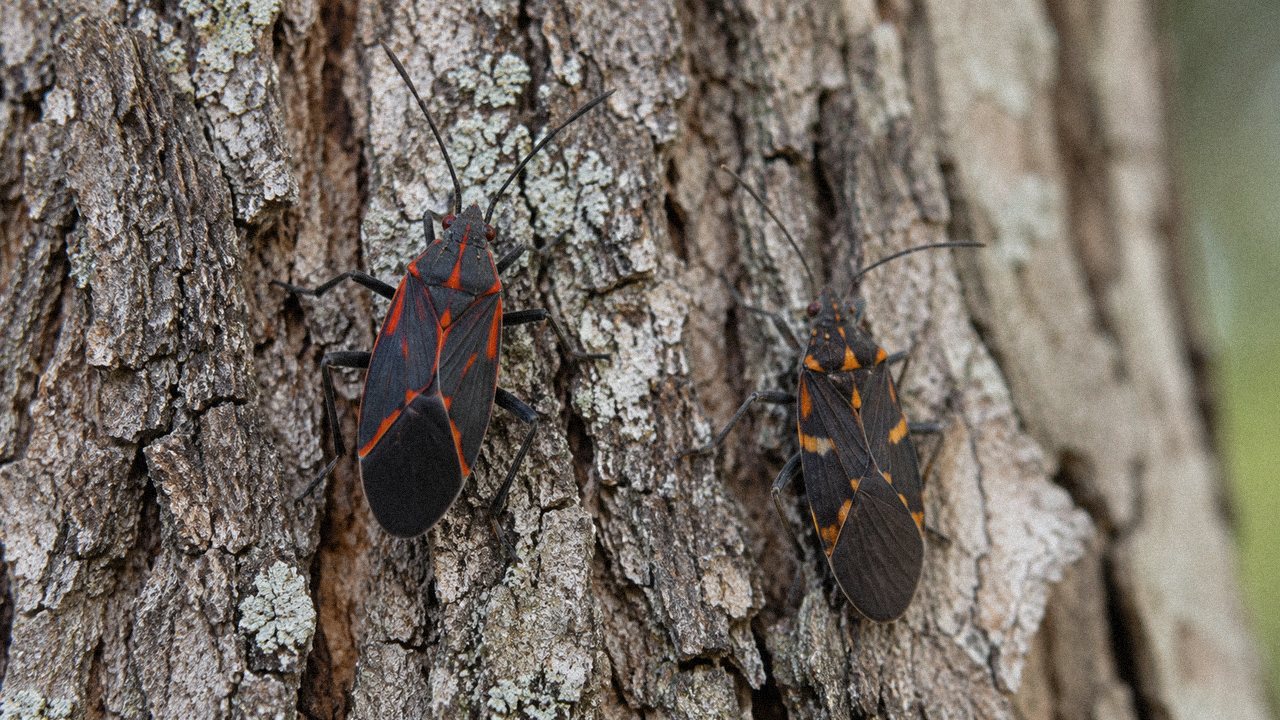
What Are Boxelder Bugs?
The boxelder bug (Boisea trivittata) is a plant-feeding insect in the scentless plant bug family (Rhopalidae). Adults are about half an inch long and black with orange or red markings, according to University of Illinois Extension. Young bugs, called nymphs, are smaller and brighter red, with undeveloped wings.
They get their name from their favorite food. The USDA Forest Service reports that the boxelder tree, a type of maple, is the most common host, and that seed clusters on female (seed-bearing) trees are their primary food. They also feed on other maples, ash, some fruit and nut trees, grapes and strawberries.
Life Cycle in Brief
Boxelder bugs develop from egg to nymph to adult, with no pupal stage. In most areas they have two generations per year, and the eggs hatch in 10 to 14 days. The second generation is usually the larger one, and its adults are the bugs that look for a place to spend the cool months. Only adults survive the winter, according to the USDA Forest Service.
Boxelder Bug or Red-Shouldered Bug? How to Tell Them Apart
The two bugs are the same size and color scheme, and both gather in large groups. Look closely at the area just behind the head and at the wings.
| Feature | Boxelder bug | Red-shouldered bug (Jadera) |
|---|---|---|
| Scientific name | Boisea trivittata | Jadera haematoloma |
| Size | About 1/2 inch | About 3/8 to 1/2 inch (9.5-13.5 mm) |
| Markings behind the head | Three red stripes | Two red stripes, the red “shoulders” |
| Wings | Red lines along the wing edges | No red on the wings |
| Nymphs | Bright red, wingless | Mostly red with brown legs and antennae |
| Main food | Seeds of female boxelder trees, also maple and ash | Seeds of balloonvine and goldenrain tree |
Oklahoma State University Extension sums up the key difference: the boxelder bug has three red stripes behind the head and red on the wing edges, while the red-shouldered bug lacks the red on its wings.
Why the Look-Alike Matters in Florida
UF/IFAS reports that Jadera haematoloma ranges across the Florida peninsula, though it is scarce in the north. In central Florida it peaks around May, but in southern Florida its activity is spread more evenly through the year. It prefers balloonvine, a vine that grows in South Florida, and commonly feeds on the seeds of goldenrain trees, a popular landscape tree. It also feeds on other plants in the soapberry family and on Ficus.
So if you see a carpet of red-and-black bugs under a goldenrain tree in Miami-Dade or Broward, you are almost certainly looking at red-shouldered bugs. The good news is that they are managed the same way.
Need help with pests in South Florida?
Toro Pest Management has protected homes and businesses since 1969. Get a free inspection and $25 off your first service, backed by our 110% Satisfaction Guarantee: if the pests come back, so do we, at no extra cost.
Why These Bugs Show Up Around Your Home
Both species follow their food and their need for shelter.
- Seed trees nearby. Large groups form under trees that drop seeds. UF/IFAS describes red-shouldered bugs gathering in colonies in yards and gardens, feeding on fallen seeds.
- Warm walls. Boxelder bugs gather on walls with large southern or western exposure, where the sun warms the siding in the afternoon.
- Cracks and gaps. From the walls, they crawl into cracks and crevices and can end up inside wall voids and attics, then wander into living spaces on warm days.
- Neighboring properties. The bugs fly, so a seed tree a few lots away can supply your house even if you have none in your own yard.
In cooler states, boxelder bugs move indoors in late summer and fall to overwinter. In South Florida, mild winters mean the bugs are less driven indoors by cold, but they still gather on sunny walls and slip in through gaps, especially when they are numerous.
Are Boxelder Bugs Dangerous?
Not to people, pets or buildings. Here is what they can and cannot do.
- Bites: Colorado State University notes that boxelder bugs rarely bite; their mouthparts are built for sucking plant juices. The UF/IFAS Charlotte County Extension office says red-shouldered bugs do not sting, bite people or cause structural damage.
- Stains: This is the main complaint. Illinois Extension notes that the bugs leave fecal spots on curtains and wallpaper, and that a crushed bug leaves a red or purple stain. UF/IFAS adds that red-shouldered bugs can stain children’s clothing red when crushed.
- Odor: Colorado State University notes that crushed bugs can give off an unpleasant smell.
- Food and fabric: Despite old claims, they do not eat carpets, drapes or clothing. Illinois Extension states they do not feed on food or clothing and do not reproduce indoors.
- Plants: The USDA Forest Service notes that they do not injure their host trees, though they can reduce seed output or mar fruit.
If you or a child has an unusual skin reaction after handling any insect, wash the area and talk to a doctor if it does not settle down.
How to Keep Boxelder Bugs Out of Your House
Prevention is far easier than chasing bugs inside the walls. Extension services agree that exclusion is the most important step.
Seal the Entry Points
- Caulk gaps around windows, door frames and the edges of siding.
- Seal openings where pipes, wires, cables and AC lines enter the house.
- Add or replace weather stripping and door sweeps.
- Repair torn window and door screens, and screen attic, soffit and crawl space vents.
- Pay extra attention to sunny south and west walls, where the bugs gather first.
Do this work before the bugs arrive in numbers. Once they are inside the walls, sealing can trap some of them indoors, where they will keep wandering out for weeks.
Remove Their Food
Rake up and dispose of fallen seeds under goldenrain trees, boxelder or maple trees, especially near the house, patios and play areas. UF/IFAS recommends raking up seeds in lawns and playgrounds as the main way to manage red-shouldered bugs. Clear leaf litter and plant debris from along sunny walls as well.
Reconsider the Host Trees
Removing trees is a big step and does not guarantee results, since bugs can fly in from other properties. The USDA Forest Service suggests removing female boxelder trees near buildings or choosing seedless varieties for new plantings. In Florida, UF/IFAS Extension notes that the goldenrain tree is listed as a Category II invasive plant, so replacing it with a native tree is a reasonable choice if you were already considering it.
How to Get Rid of Boxelder Bugs Already Inside
- Vacuum them up. This is the cleanest method. Empty the bag or canister outside into a sealed bag right away so the smell does not linger. Do not crush them on curtains, walls or carpet.
- Use soapy water outdoors. For groups on walls or pavement, the USDA Forest Service suggests a simple soap-and-water spray. Keep it off plant leaves, which it can damage.
- Hand-collect small groups. UF/IFAS suggests simply collecting small concentrations of red-shouldered bugs on plants.
- Skip the bug bombs. The USDA Forest Service calls chemical control a last resort that is rarely needed, and notes that boxelder bugs have developed resistance to many insecticides.
Boxelder bugs are one of several outdoor insects that wander indoors looking for shelter. Our guide to stink bugs and how to remove them without the smell covers a similar invader, and everything you need to know about stink bugs explains that group in more depth. Tiny red clover mites are another look-alike nuisance that leaves red smears when crushed.
When to Call a Pest Professional
Most boxelder and red-shouldered bug problems can be handled with sealing, raking and a vacuum. Call a professional when:
- Bugs keep appearing indoors for weeks even after you seal the obvious gaps
- You cannot find where they are getting in, or they are coming from the attic or wall voids
- You are not sure what the bug is and want it identified
- Other pests, such as ants or cockroaches, are also getting in through the same gaps
Toro Pest Management has protected South Florida homes since 1969, with technicians trained at the TORO Institute alongside on-staff entomologists. A free inspection identifies the insect, finds the entry points and recommends a plan. For ongoing protection inside and outside the home, see Toro’s residential pest control services. You can also browse the Toro pest library to identify other insects around your property, or read about backyard pests that may be planning a home invasion.

Contact Toro today
A free inspection & $25 off your first service
A trained Toro technician inspects your home or business, explains what was found and gives you a clear plan and quote, backed by our 110% Satisfaction Guarantee.
305-594-4767Frequently Asked Questions
Are boxelder bugs harmful to humans?
What attracts boxelder bugs to my house?
Do red-shouldered bugs damage plants?
Will boxelder bugs lay eggs in my house?
Should I cut down my goldenrain tree to get rid of the bugs?
Sources
- Jadera Bugs, Jadera haematoloma and J. antica (EDIS IN287), UF/IFAS Extension
- The Jadera Bug and the Golden Rain Tree: A Love Story, UF/IFAS Extension Charlotte County
- Boxelder Bugs (Forest Insect and Disease Leaflet 95), USDA Forest Service
- Boxelder Bug, University of Illinois Extension
- Boxelder Bug, Redshouldered Bug, Oklahoma State University Extension
- Boxelder Bug, Colorado State University Agricultural Biology
Educational content. This article is for general information about pests in South Florida and is not medical, legal or professional advice. If you have a bite, sting or allergic reaction, contact your doctor; in an emergency, call 911. Pest problems vary from home to home, so a licensed professional should inspect before treatment. When using any pesticide, always read and follow the product label.


