
Key takeaways
- Hornets and yellowjackets have smooth stingers, so one wasp can sting many times, unlike a honey bee worker.
- An injured or alarmed hornet releases a chemical signal that brings the rest of the colony out to defend the nest.
- Florida's native hornet, the baldfaced hornet, is technically a yellowjacket; the so-called murder hornet was declared eradicated from the US in December 2024.
- The invasive yellow-legged hornet reached Georgia in 2023; Florida asks residents to report suspected sightings to FDACS.
- Trouble breathing, throat or chest tightness or fainting after a sting is an emergency: call 911.
In this article
- What Is a Hornet, Exactly?
- Why Hornet Stings Are So Dangerous
- Hornets and Look-Alikes: How They Compare
- The “Murder Hornet” Myth and the Hornet Florida Is Watching
- Signs of a Hornet Nest Near Your Home
- What to Do If You Are Stung
- How to Avoid Hornet Stings
- Should You Remove a Hornet Nest Yourself?
- Frequently Asked Questions
Hornets are dangerous because of how they defend their nest: one hornet can sting again and again, and an alarmed hornet calls the rest of the colony out to join the attack. For most people that means several painful stings at once; for people with a sting allergy, it can be a medical emergency.
The scary headlines about “murder hornets” add confusion. The giant Asian hornet behind that nickname never reached Florida and has been declared eradicated from the United States. The hornets and hornet-like wasps that live in Florida are native species, mainly the baldfaced hornet and its yellowjacket relatives, and they are dangerous enough on their own. This guide explains what makes them risky, which species live here, how to recognize a nest and what to do about it.
What Is a Hornet, Exactly?
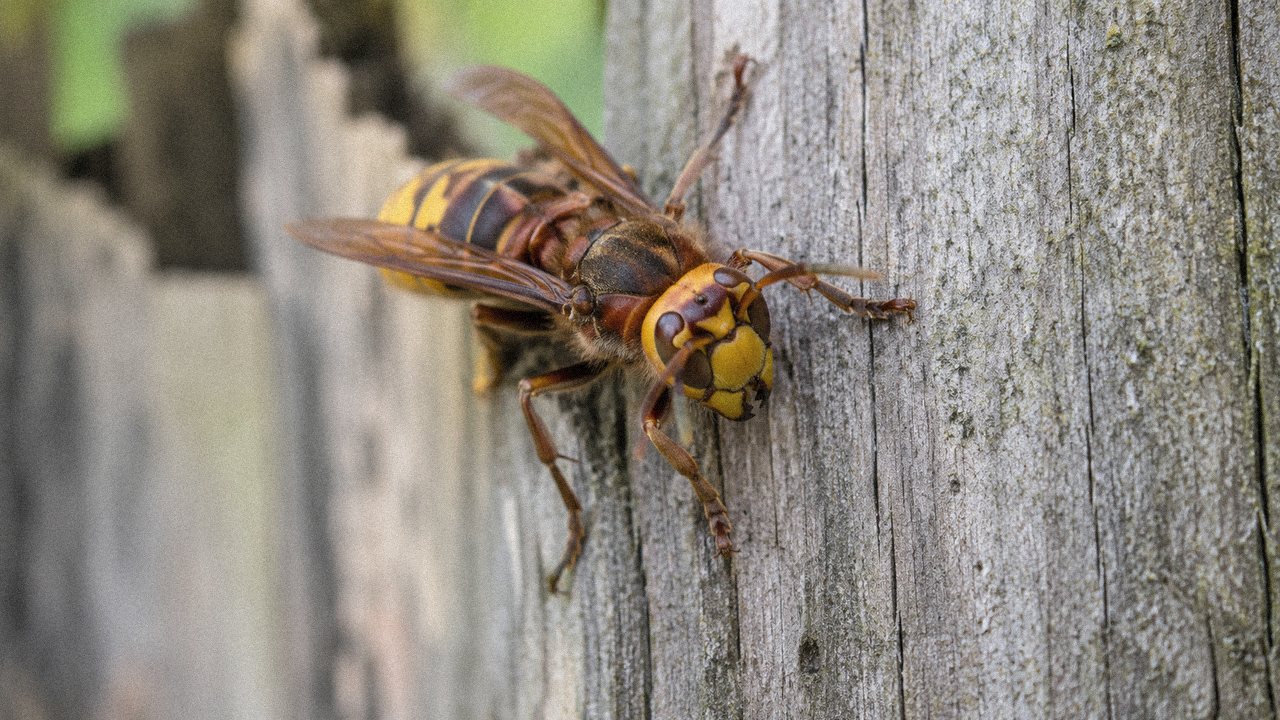
“Hornet” is used loosely. Scientists reserve it for wasps in the genus Vespa, a group of large social wasps from Europe and Asia. In everyday American English, though, people call almost any big, aggressive paper-nest wasp a hornet.
The species that matter in Florida are:
- Baldfaced hornet (Dolichovespula maculata): black and white, builds large, enclosed paper nests in trees, shrubs and on buildings, often a foot or more across. UF/IFAS points out that it is technically a yellowjacket, not a true hornet.
- Eastern and southern yellowjackets (Vespula maculifrons and V. squamosa): the only two of the 18 North American Vespula species found in Florida, according to UF/IFAS. Most nest underground, but the southern yellowjacket also builds aerial nests, including in palm material.
- European hornet (Vespa crabro): a true hornet and, according to University of Georgia Extension, the largest hornet species found in the United States. UGA describes it as widespread across much of the eastern US and especially common in Georgia. Workers are about 1 inch long and queens about 1.3 inches. UF/IFAS’s Florida yellowjacket and hornet guide does not list it among the state’s common vespids.
Hornets and yellowjackets are not useless. UF/IFAS notes that they kill many insects that attack ornamental and food plants, and caterpillars are a favorite food. The trouble starts when a colony builds where people live, work and play.
Why Hornet Stings Are So Dangerous
They Can Sting Repeatedly
A honey bee worker’s stinger is barbed, so it stays in the skin and the bee dies. Hornets and yellowjackets have a smooth stinger that pulls back out. UF/IFAS stresses that, unlike honey bees, these wasps can sting repeatedly, and University of Georgia entomologists note that European hornets leave no stinger behind for the same reason.
They Recruit the Whole Colony
The real danger is numbers. According to UF/IFAS, an injured yellowjacket or hornet releases an alarm pheromone that triggers aggressive defense by other members of the colony, and workers are especially aroused when the nest is threatened. Colonies hold hundreds to thousands of wasps; one eastern yellowjacket nest UF/IFAS described had more than 2,800. Bump a nest with a hedge trimmer and you may face dozens of defenders, not one.
Allergic Reactions
For most people, a sting causes pain, redness and swelling at the site. Some people develop a large local reaction that spreads well beyond the sting. A smaller group can have anaphylaxis, which the CDC’s National Institute for Occupational Safety and Health describes as a severe and potentially life-threatening allergic reaction that requires immediate emergency care. Anyone with a history of severe reactions should carry their prescribed epinephrine auto-injector and wear a medical ID.
Nests in the Wrong Place
Most stings are accidents. People mow over a ground nest, trim a hedge that hides an aerial nest, open a hurricane shutter or reach under a railing. In South Florida, the long warm season, heavy summer rain and plentiful insect food give colonies time to grow large, and homes offer endless sheltered nest sites: eaves, soffits, pool cages, light fixtures and palms.
Need help with pests in South Florida?
Toro Pest Management has protected homes and businesses since 1969. Get a free inspection and $25 off your first service, backed by our 110% Satisfaction Guarantee: if the pests come back, so do we, at no extra cost.
Hornets and Look-Alikes: How They Compare
| Species | In Florida? | Nest | Why it matters |
|---|---|---|---|
| Baldfaced hornet | Yes, native to Florida | Large enclosed gray paper nest in trees, shrubs or on buildings | Defends its nest and stings repeatedly |
| Southern yellowjacket | Yes, native | Underground, or aerial in palm material and garages | Large colonies; often hit by mowers |
| Eastern yellowjacket | Yes, native | Mostly underground | Colonies of hundreds to thousands |
| European hornet | Widespread in the eastern US; not covered in UF/IFAS’s Florida yellowjacket guide | Hollow trees, sheds, attics and wall voids | Large, active at night, strips bark from shrubs |
| Yellow-legged hornet | Found in Georgia since 2023; Florida asks residents to report sightings | Large aerial nests | Invasive predator of honey bees |
| Northern giant hornet (“murder hornet”) | No; eradicated from the US in 2024 | Underground | Was found only in the Pacific Northwest |
| Paper wasps | Yes, very common | Open, umbrella-shaped comb under eaves | Not hornets, but sting repeatedly near the nest |
For more on the paper wasps that nest on so many South Florida homes, read what paper wasps do in winter.
The “Murder Hornet” Myth and the Hornet Florida Is Watching
The northern giant hornet (Vespa mandarinia), once called the Asian giant hornet, is a very large hornet, with bodies about 1.5 to 2 inches long. It was first reported in 2019 on Vancouver Island and in northwestern Washington State. In December 2024, the Washington State Department of Agriculture and the USDA announced that it had been eradicated from the United States, according to the University of Rhode Island’s biocontrol program. It never established in Florida.
The hornet Florida officials do want you to watch for is the yellow-legged hornet (Vespa velutina). It was first found in the US in Savannah, Georgia, in August 2023, after a backyard beekeeper captured and reported it. It preys on honey bees, and UF/IFAS warns that North American honey bees have no natural defenses against it. Look for:
- Yellowish legs, its most distinctive feature
- A body about 1.2 to 3 cm long
- An orange-yellow face with large eyes
- A mostly dark body with a single yellow band near the tip of the abdomen
FDACS notes that it can be confused with Florida’s native southern yellowjacket, eastern yellowjacket and baldfaced hornet. If you think you have seen one, photograph it from a safe distance and report it to FDACS at 1-888-397-1517.
Signs of a Hornet Nest Near Your Home
- Wasps flying repeatedly to one spot in a tree, shrub, palm, eave or shed
- A gray, papery, football-shaped or round nest hanging from a branch or overhang
- Wasps flying low over the lawn and in and out of a hole in the ground
- Large wasps buzzing around porch lights at night, a habit of European hornets
- Stripped or girdled bark on shrub branches, a sign of European hornets collecting sap and fiber
- Yellowjackets crowding garbage cans, fallen fruit and outdoor drinks
What to Do If You Are Stung
The CDC’s National Institute for Occupational Safety and Health (NIOSH) recommends these first aid steps for bee, wasp and hornet stings:
- Move away from the nest area first, quickly and calmly. If many insects attack, run and get indoors or into a shaded area. Do not jump into water, since some insects hover above it.
- Have someone stay with the person to watch for signs of an allergic reaction.
- Wash the sting with soap and water.
- Apply ice to reduce swelling, and do not scratch, which can increase swelling, itching and infection risk.
- If a stinger is left behind (usually a honey bee), scrape it out with a fingernail or gauze rather than squeezing it.
See a doctor if swelling keeps spreading, the area looks infected, or a child or pet has been stung several times. Pets are at risk too; our article on dangerous pests for pets covers what to watch for.
How to Avoid Hornet Stings
- Do not swat. NIOSH advises staying calm and still if a single stinging insect is flying nearby.
- Dress smart outdoors. NIOSH recommends light-colored, smooth clothing that covers your skin and skipping perfume, cologne and scented toiletries.
- Cover food and drinks. UF/IFAS recommends keeping soft drinks, ripe fruit and watermelon covered outdoors, picking fruit as it ripens and discarding rotten fruit.
- Close the trash. Tight lids keep yellowjackets away from food waste.
- Check sheltered spots such as shutters, grills, mailboxes and pool cage corners every few weeks in spring and summer, when nests are still small.
Plants are often promoted as a way to keep wasps away, but they are no substitute for removing food sources and finding nests early. Read more about plants said to repel wasps before relying on them.
Should You Remove a Hornet Nest Yourself?
UF/IFAS recommends hiring a pest control operator for large nests and nests that are hard to reach, such as those inside walls. University of Georgia Extension adds two practical points: look inside wall voids, where nests are often hidden, and do not seal a nest entrance, which leaves the colony alive behind the wall.
Leave it to a professional when:
- The nest is high, inside a wall, attic, shed or the ground
- It is near a door, pool, play area or walkway
- Anyone in the household is allergic to stings
- You are not sure whether it is hornets, yellowjackets or a honey bee colony, which needs different handling in Florida
Toro’s Total Home Protection Gold 365 program includes removing wasp nests outside your home as part of its every-other-month service. Property managers, restaurants and hotels can ask about commercial pest control for nests near entrances and outdoor seating. Toro has protected South Florida homes and businesses since 1969, responds within 24 hours, guaranteed, and starts with a free inspection.

Contact Toro today
A free inspection & $25 off your first service
A trained Toro technician inspects your home or business, explains what was found and gives you a clear plan and quote, backed by our 110% Satisfaction Guarantee.
305-594-4767Frequently Asked Questions
Are there murder hornets in Florida?
What happens if a hornet stings you?
Can a hornet sting you more than once?
Do hornets come out at night?
What is the difference between a hornet and a yellowjacket?
Sources
- Yellowjackets and Hornets, Vespula and Dolichovespula spp. (Insecta: Hymenoptera: Vespidae), UF/IFAS Extension
- UF/IFAS experts urge residents to watch for, report predatory yellow-legged hornets, UF/IFAS News
- Differentiating Florida Native Wasps From Yellow-Legged Hornet: A Comparison Guide, Florida Department of Agriculture and Consumer Services
- European Hornet: The Largest Hornet in Georgia, University of Georgia Cooperative Extension
- Insects and Scorpions at Work, CDC, National Institute for Occupational Safety and Health
- Northern Giant Hornet, University of Rhode Island Biocontrol Lab
Educational content. This article is for general information about pests in South Florida and is not medical, legal or professional advice. If you have a bite, sting or allergic reaction, contact your doctor; in an emergency, call 911. Pest problems vary from home to home, so a licensed professional should inspect before treatment. When using any pesticide, always read and follow the product label.


