
Key takeaways
- Fire ant mating flights usually happen at midday on a warm, sunny day after rain, with up to 4,500 winged ants per flight (UF/IFAS).
- Florida carpenter ants fly in the evening or at night during the rainy season, May through November.
- Ants have elbowed antennae, a pinched waist and unequal wings; termites have straight antennae, a thick waist and four equal wings.
- Winged ants coming from inside walls or floors suggest an indoor nest; a few at a window after a storm usually flew in.
- After floods, fire ants can float as living rafts and hide in debris, so handle storm debris with gloves and tools.
In this article
- Two Kinds of Ant Swarms After a Storm
- Why Rain Triggers Ant Mating Flights
- Which Ants Swarm in South Florida, and When
- Flying Ant or Termite? How to Tell in 10 Seconds
- Do Flying Ants Indoors Mean an Infestation?
- After Hurricanes: Flooded Colonies and Floating Fire Ants
- What to Do When Ants Swarm Around Your Home
- When to Call a Professional
- Frequently Asked Questions
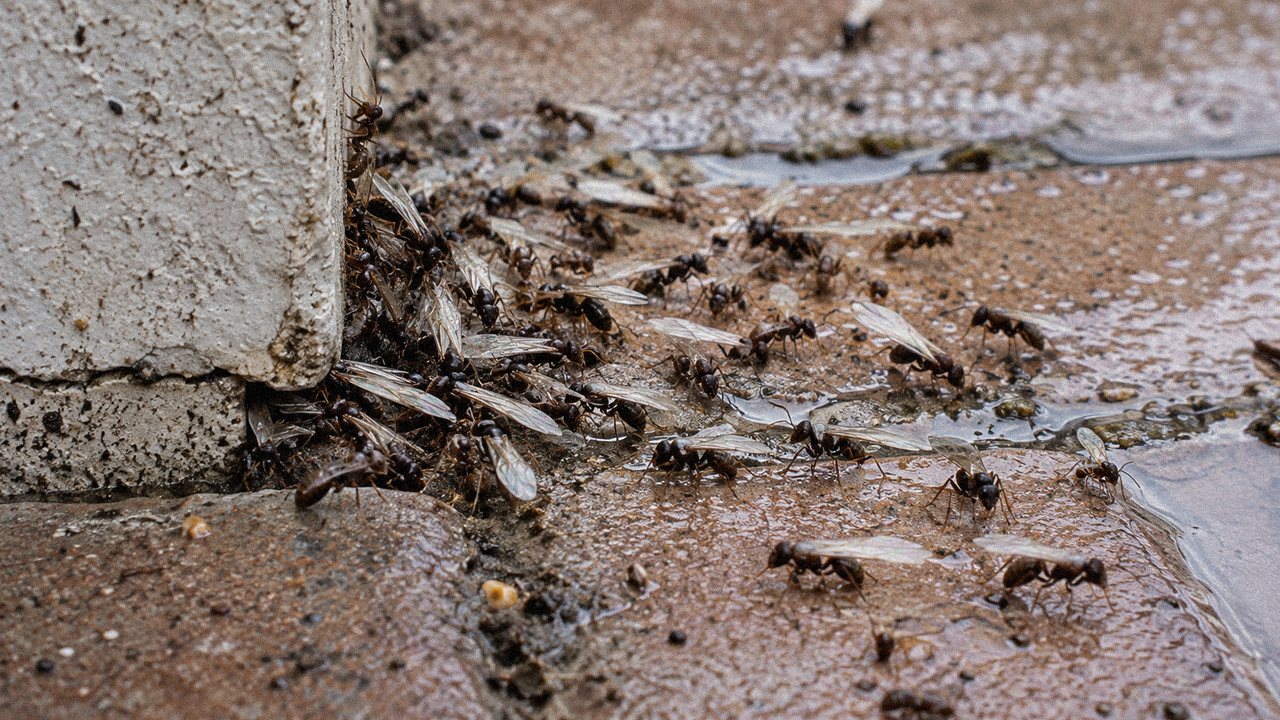
Ants swarm after storms because rain is the signal many colonies wait for to release their winged queens and males on mating flights. The cloud of flying ants you see on a warm, sunny afternoon after a downpour is a reproductive event, not an invasion, and it tells you that mature colonies live nearby.
In South Florida, storms can cause a second kind of “swarm” too: flooded colonies that move to higher, drier ground, sometimes onto porches, debris piles or into homes. This guide explains both, shows which ants fly in which season, helps you tell flying ants from termite swarmers and tells you when a swarm is a sign of a real problem.
Two Kinds of Ant Swarms After a Storm
- Mating flights. Mature colonies produce winged reproductives, called alates. When the weather is right, they leave the nest together, mate in the air and land to start new colonies. These are the flying ants that cover windows, pool surfaces and patios after rain.
- Displaced colonies. Heavy rain saturates the soil, and colonies move workers, brood and queens to drier places. These ants walk rather than fly, and they show up as sudden trails or masses along slab edges and in debris.
The first is a nuisance that tells you colonies are nearby. The second is the one more likely to bring ants indoors; our article on how ants migrate indoors during South Florida storms covers it in detail.
Why Rain Triggers Ant Mating Flights
Mating flights need the right conditions, and a storm followed by sunshine often provides them. For the red imported fire ant, UF/IFAS reports that mating flights usually occur at midday on a warm day above 74°F, sunny and following rain. Colonies start producing winged reproductives once they are about a year old.
The numbers are large. According to UF/IFAS, fire ant colonies have six to eight mating flights a year between spring and fall, with up to 4,500 alates per flight, and up to 97,000 queens may be produced per acre of infested land each year in the southern United States. Mating happens in the air, the males die soon after, and newly mated queens land to look for a place to start a colony.
Because neighboring colonies respond to the same weather, flights from many nests happen at once. That is why a whole neighborhood can seem to fill with winged ants on the same afternoon, and why thousands can collect on the surface of a swimming pool, which UF/IFAS notes attracts them.
Need help with pests in South Florida?
Toro Pest Management has protected homes and businesses since 1969. Get a free inspection and $25 off your first service, backed by our 110% Satisfaction Guarantee: if the pests come back, so do we, at no extra cost.
Which Ants Swarm in South Florida, and When
Different ants fly in different seasons and at different times of day. Fire ants fly in the middle of the day; Florida carpenter ants fly in the evening or at night; termites, which are often confused with ants, have their own windows.
active peak
Source: UF/IFAS EDIS (IN455, IN551, IN278)
| Swarmer | Season in Florida | Time of day | What to know |
|---|---|---|---|
| Red imported fire ant | Six to eight flights between spring and fall | Midday, warm and sunny after rain | Flights start from lawn and landscape mounds; workers defend the mound |
| Florida carpenter ant | Rainy season, May through November; complaints peak April to June | Evening or night | Winged ants often appear around windows and sliding doors |
| White-footed ant | Usually July to August in South Florida | Not specified | Huge colonies in palms, leaf litter, gutters and attics |
| Formosan subterranean termite | Early April to late June, peak in May | Shortly after sunset | Not an ant; drawn to lights; orange to amber-brown |
The Florida carpenter ant, according to UF/IFAS, flies in the evening or at night during the rainy season, and complaints peak between April and June, when winged ants appear around windows and sliding doors. UF/IFAS reports that white-footed ants usually release their winged forms between July and August in South Florida.
Flying Ant or Termite? How to Tell in 10 Seconds
Getting this right matters, because termites need a completely different treatment. UF/IFAS Extension in Nassau County gives three quick checks:
- Antennae. Ants have elbowed, bent antennae. Termite antennae are straight.
- Waist. Ants have a distinct, pinched waist. Termites have a thick, solid body.
- Wings. Ant wings are unequal, with the hind pair shorter than the front pair. Termite wings are equal in length and much longer than the body.
Do not rely on color, since both insects vary. Termites also fly a short distance, drop to the ground and shed their wings, so piles of identical wings on a windowsill point toward termites. Swarmers may or may not still have wings when you find them. For side-by-side photos and more detail, see our guide to termites vs. flying ants.
Do Flying Ants Indoors Mean an Infestation?
Not always. Where the winged ants come from is the key.
- A few at a window or door after a storm usually flew in from outside, often drawn by light.
- Many emerging from a wall, baseboard, outlet or ceiling suggests a mature colony nesting inside the structure.
- Large, two-toned winged ants at night near a damp window frame point to Florida carpenter ants, which UF/IFAS says nest close to moisture, including under windows and door frames where rain or sprinklers soak in.
- Swarmers with equal wings and straight antennae are termites, not ants, and need a termite inspection.
A colony has to be well established before it produces winged reproductives, so a swarm from inside your home means the nest has been there a while.
After Hurricanes: Flooded Colonies and Floating Fire Ants
Hurricanes and tropical storms bring a different hazard. Texas A&M AgriLife Extension notes that floodwaters will not drown fire ants: colonies rise from the soil, clump together and float until they reach dry ground or an object they can climb. As the water goes down, they may settle in debris piles or inside homes and buildings before moving back into the soil, and they can be under debris, in furniture and under carpet strips.
That makes cleanup the riskiest time. Wear gloves, long sleeves, long pants, socks and closed shoes, and move debris with a shovel or other tool rather than your hands. Our article on how fire ants survive flood waters explains the living rafts and how to stay safe around them.
What to Do When Ants Swarm Around Your Home
- Leave outdoor swarms alone. Spraying flying ants does nothing to the colonies they came from.
- Vacuum or sweep winged ants indoors and empty the vacuum outside.
- Turn off unneeded outdoor lights in the evening during carpenter ant and termite season, and close windows and sliding doors.
- Skim the pool to remove floating swarmers.
- Collect a sample before you clean up if you are not sure what they are.
- Treat mounds once the ground is dry. Texas A&M notes fire ant baits are ineffective right after a flood because workers are not foraging.
- Seal and trim. Close gaps around pipes, cables and doors, and trim branches that touch the house.
When to Call a Professional
Call for an inspection when winged insects come from inside walls or floors, when you see swarmers in the same room more than once, when you find piles of discarded wings, or when you are not sure whether they are ants or termites. A Toro technician identifies the insect, locates the nest and treats it with products chosen for that species and applied according to the label.
For fire ants and other lawn insects, Toro’s lawn spray service uses power lawn sprays and granules. If the swarmers turn out to be termites, our termite control team starts with a free inspection. For year-round coverage inside and outside, ask about Total Home Protection Gold 365. Toro has protected South Florida since 1969 and responds within 24 hours, guaranteed.

Contact Toro today
A free inspection & $25 off your first service
A trained Toro technician inspects your home or business, explains what was found and gives you a clear plan and quote, backed by our 110% Satisfaction Guarantee.
305-594-4767Frequently Asked Questions
Why are there so many flying ants after it rains?
Do flying ants bite or sting?
Are flying ants a different kind of ant?
Should I call a professional if I see flying ants?
Do ants come inside before a hurricane?
Sources
- Red Imported Fire Ant, Solenopsis invicta Buren (Insecta: Hymenoptera: Formicidae: Myrmicinae), UF/IFAS Extension
- Florida Carpenter Ant, Bull Ant, Tortugas Carpenter Ant, Camponotus floridanus (Buckley) and Camponotus tortuganus (Emery) (Insecta: Hymenoptera: Formicidae: Subfamily Formicinae: Tribe Camponotini), UF/IFAS Extension
- White-Footed Ant, Technomyrmex difficilis (=albipes) Forel (Insecta: Hymenoptera: Formicidae: Dolichoderinae), UF/IFAS Extension
- Formosan Subterranean Termite, Coptotermes formosanus Shiraki (Insecta: Blattodea: Heterotermitidae (formerly Rhinotermitidae)), UF/IFAS Extension
- Q: I found hundreds of flying insects swarming in my back yard. Will you be able to identify whether they are ants or termites?, UF/IFAS Extension Nassau County
- Flooding and Fire Ants, Texas A&M AgriLife Extension
Educational content. This article is for general information about pests in South Florida and is not medical, legal or professional advice. If you have a bite, sting or allergic reaction, contact your doctor; in an emergency, call 911. Pest problems vary from home to home, so a licensed professional should inspect before treatment. When using any pesticide, always read and follow the product label.


