
Key takeaways
- The most reliable signs are under the leaves: flat, oval nymphs, empty pupal cases and silvery shed skins. Ficus whitefly adults live only 2 to 4 days, so they are a poor indicator.
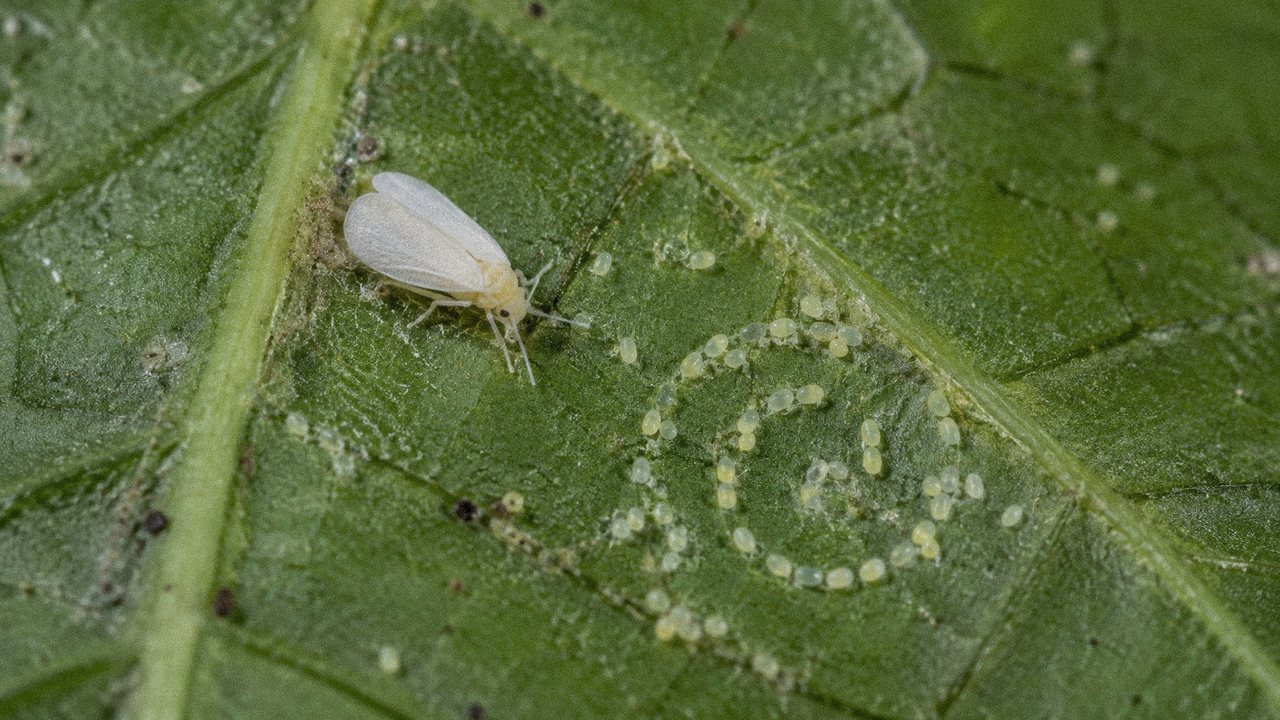
- White waxy spirals on leaves, walls or cars point to the rugose spiraling whitefly, found in Florida since 2009.
- Ficus hedges that yellow and drop leaves may have had ficus whitefly for months before the damage shows.
- Sooty mold is a fungus growing on whitefly honeydew, not a plant disease, and it usually fades once the whiteflies are controlled.
In this article
The clearest signs of whiteflies are a cloud of tiny white insects when you brush a plant, yellowing or falling leaves, sticky honeydew and black sooty mold. The proof, though, is under the leaves, where the immature stages feed without moving.
Whiteflies are easy to miss early. According to UF/IFAS, infestations often go unnoticed until leaves turn yellow or drop, or until someone shakes a plant and a cloud of adults flies up. By then, the population has usually been growing for several generations. This guide shows you what each sign means, how to check your plants in a few minutes and which whitefly you are probably dealing with in South Florida.
What Whiteflies Are and Why South Florida Has So Many
Whiteflies are not true flies. They are small sap-feeding insects related to aphids, mealybugs and scales. Adults have white, waxy wings and live only a short time; the damage comes mostly from the flat, oval nymphs that stay fixed to the underside of a leaf and feed through needle-like mouthparts.
Florida has many whitefly species, and UF/IFAS notes that new invasive pests keep arriving. Development from egg to adult takes about 4 weeks in summer and up to 6 months in winter, so South Florida’s long warm season lets populations stack one generation on top of another. Our article on why whiteflies spread so fast in South Florida explains that growth in detail.
The Whiteflies You Are Most Likely to Find
| Whitefly | Main plants | What to look for |
|---|---|---|
| Ficus whitefly | Ficus only, especially weeping fig (Ficus benjamina) hedges | Gnat-sized adults with yellow bodies and white wings with a faint gray band; yellowing leaves, then heavy leaf drop |
| Rugose spiraling whitefly | Gumbo limbo, coconut and other palms, avocado, black olive, Calophyllum and many more | Spirals of eggs covered in white wax; fluffy white wax and lots of honeydew |
| Bondar’s nesting whitefly | Ornamental landscape plants | Nymphs surrounded by wax “nests” under the leaves |
| Silverleaf and other common whiteflies | Vegetables, annuals and many ornamentals | Clouds of small white adults; sticky leaves and sooty mold |
Toro’s whitefly pest library page has photos of these species if you want to compare.
The 5 Main Signs of a Whitefly Infestation
Check for these in order, from the easiest to notice to the most conclusive.
Sign 1: A Cloud of Tiny White Insects
Brush or shake the plant and watch. Whitefly adults rise in a small cloud and then settle back on the leaves within seconds. FDACS describes rugose spiraling whitefly adults rising “in clouds” from infested foliage.
Seeing adults confirms whiteflies are present, but it does not tell you how bad the problem is. Ficus whitefly adults live only 2 to 4 days, according to Palm Beach County Extension, so the number you see flying says little about the size of the infestation. Always check the nymphs too.
Sign 2: Nymphs, Pupal Cases and Silvery Spots Under the Leaves
Turn over several leaves from different parts of the plant, especially the inner and lower foliage. Look for:
- Nymphs: tiny, flat, oval scales that do not move. Ficus whitefly nymphs are tan to light green with red eyes, according to UF/IFAS Monroe County Extension.
- Pupal cases: the last immature stage, often the easiest to see. Empty cases with a slit show that adults have already emerged.
- Silvery spots: shed skins left on the underside of the leaf.
- Parasitized nymphs: UF/IFAS notes that a parasitized nymph contains the larva or pupa of a tiny parasitic wasp, and a small round emergence hole may be visible once the wasp leaves, a good sign that natural enemies are working.
A 10x hand lens makes this much easier. Extension entomologists recommend scouting for these immature stages rather than relying on the adults you see flying.
Sign 3: Yellowing, Wilting and Falling Leaves
As whiteflies drain sap, leaves turn yellow, wilt and eventually drop. Branches may also die back, although Palm Beach County Extension notes that dieback is highly variable from plant to plant.
Timing matters. Ficus can drop leaves for many reasons, including drought and transplant stress, but UF/IFAS notes that ficus whitefly causes leaf drop only after several months of infestation. A hedge that is suddenly thin has usually been infested for a while. For the full story on hedges, read why whiteflies are destroying ficus hedges across Florida.
Sign 4: Sticky Honeydew and Black Sooty Mold
Whiteflies excrete honeydew, a clear, sticky liquid. You may feel it on leaves or find it as a shiny film on cars, patio furniture and pavers under infested trees.
Sooty mold, a black fungus, grows on that honeydew. UF/IFAS stresses that it is not a plant disease, but heavy coverage blocks light and can reduce photosynthesis, growth and leaf retention. It usually weathers away once the insects are controlled. If your hedge or palms are turning black, our article on the whitefly sooty mold problem covers cleanup and recovery.
Ants are another clue. They feed on honeydew, so ant trails running up a tree or hedge often lead to sap-feeding insects such as whiteflies.
Sign 5: White Waxy Spirals and Fluffy Wax
The rugose spiraling whitefly was first collected in Florida from gumbo limbo in Miami-Dade County in March 2009, according to FDACS. Females lay eggs in spiral patterns covered with white wax, and the nymphs produce dense, cottony wax. FDACS notes that when populations are high, females lay eggs on almost any surface, so spirals can turn up on things other than leaves.
UF/IFAS describes this wax as harmless to plants and animals, and it fades quickly once the whiteflies are under control. It is still the easiest whitefly sign to recognize from a distance.
Need help with pests in South Florida?
Toro Pest Management has protected homes and businesses since 1969. Get a free inspection and $25 off your first service, backed by our 110% Satisfaction Guarantee: if the pests come back, so do we, at no extra cost.
Signs at a Glance: What Each One Means
| What you see | What it usually means | What to do next |
|---|---|---|
| Cloud of white insects when you brush the plant | Adult whiteflies present | Check leaf undersides for nymphs |
| Flat ovals, pupal cases, silvery spots under leaves | Active breeding infestation | Identify the species before treating |
| Yellowing and dropping ficus leaves | Ficus whitefly present for months | Get an inspection promptly |
| Sticky film on leaves, car or patio | Honeydew from sap feeders | Wash surfaces; find the source plant |
| Black coating on leaves | Sooty mold growing on honeydew | Control the insects; mold fades later |
| White waxy spirals | Rugose spiraling whitefly eggs | Check palms and nearby trees |
| Nymphs or cases with a small round exit hole | Parasitized whiteflies | Avoid broad sprays that kill natural enemies |
Look-Alikes: What Is Not a Whitefly
Several problems are mistaken for whiteflies:
- Powdery mildew is a white, dusty fungus on the leaf surface. Palm Beach County Extension specifically notes that it is not whitefly.
- Mealybugs are soft, cottony insects that cluster in leaf joints and on stems, and they move slowly.
- Scale insects also produce honeydew and sooty mold but stay fixed under waxy or hard covers.
- Drought or transplant stress can make ficus drop leaves with no insects present.
Because treatments differ, UF/IFAS advises confirming the insect’s identity before you act.
What to Do When You Find the Signs
Start with steps that do not make the problem worse:
- Confirm and identify. Look for live nymphs, not just adults or old wax.
- Keep plants healthy. UF/IFAS notes that proper watering and fertilizing reduce plant stress.
- Skip heavy pruning. UF/IFAS says infested trees do not need to be pruned or removed, and most survive.
- Try soft options on small plants. For small infestations, Palm Beach County Extension lists washing the plants with water, insecticidal soap or horticultural oil, applied thoroughly to the leaf undersides and repeated, with every product used according to its label.
- Protect natural enemies. Broad foliar sprays kill the beetles, lacewings and parasitic wasps that help keep whiteflies down.
When to Call a Professional
Call for an inspection when a ficus hedge is thinning, when palms or large trees are dripping honeydew, when the problem returns after you treat it, or when you are not sure what you are seeing. Large trees and long hedges are hard to treat thoroughly from the ground, and the right approach depends on the species.
Toro’s whitefly control service starts with a free inspection of your ficus hedges, palms and trees, including the underside of the leaves, to identify which whitefly you have and how heavy the infestation is. You get a clear plan and a quote before any work begins, then treatment of the infested plants and checks for new activity. Toro has protected South Florida landscapes since 1969, and if the bugs come back, so will Toro, at no additional cost to you. To see what happens when signs are ignored, read why ignoring whiteflies can cost you more.

Contact Toro today
A free inspection & $25 off your first service
A trained Toro technician inspects your home or business, explains what was found and gives you a clear plan and quote, backed by our 110% Satisfaction Guarantee.
305-594-4767Frequently Asked Questions
What do whitefly eggs look like?
Are the white flies on my plants always whiteflies?
Can whiteflies kill a plant?
Is there a season for whiteflies in South Florida?
Should I cut back a hedge that has whiteflies?
Sources
- Take a Good Look at Your Ficus Hedge, UF/IFAS Extension Monroe County
- Whiteflies on Landscape Ornamentals (ENY-317), UF/IFAS Extension
- The Rugose Spiraling Whitefly, Aleurodicus rugioperculatus Martin, a New Exotic Whitefly in South Florida (Hemiptera: Aleyrodidae), Florida Department of Agriculture and Consumer Services, Division of Plant Industry
- Frequently Asked Questions (FAQs), UF/IFAS Entomology and Nematology Department
- Whitefly in the Landscape, UF/IFAS Extension Palm Beach County
Educational content. This article is for general information about pests in South Florida and is not medical, legal or professional advice. If you have a bite, sting or allergic reaction, contact your doctor; in an emergency, call 911. Pest problems vary from home to home, so a licensed professional should inspect before treatment. When using any pesticide, always read and follow the product label.


