
Key takeaways
- Most of the mess comes from honeydew, a sticky liquid whiteflies excrete, which drips onto cars, patios and furniture and feeds black sooty mold.
- Rugose spiraling whitefly, found in Miami-Dade since 2009, feeds on more than 118 host plants and can lay egg spirals on cars, walls and windows.
- Whiteflies feed on plant sap; their honeydew attracts stinging ants and wasps, and the white wax is harmless to plants and animals (UF/IFAS).
- Honeydew, wax and sooty mold usually wear off once the whiteflies are controlled, so treating the source plant beats endless cleaning.
In this article
- Why Whiteflies Thrive Around South Florida Homes
- Sticky Honeydew on Cars, Patios and Pools
- Black Sooty Mold on Leaves, Walls and Screens
- White Wax, Egg Spirals and Clouds of Tiny Insects
- Ants, Wasps and Other Unwanted Visitors
- Are Whiteflies Harmful to People or Pets?
- Nuisance Guide: What Causes It and What Fixes It
- What You Can Do Now
- When to Call a Professional
- Frequently Asked Questions
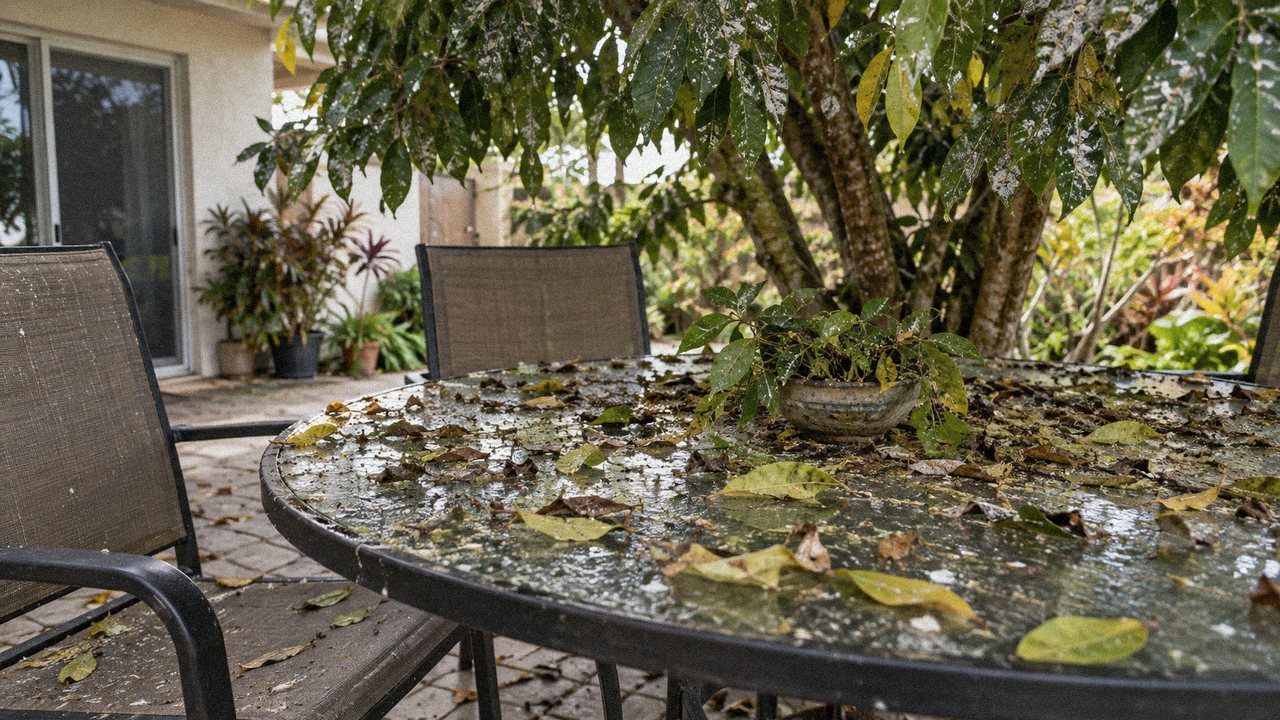
Whiteflies are a major nuisance in South Florida homes because their mess does not stay on the plant. They excrete sticky honeydew that drips onto cars, patios, pool decks and furniture, black sooty mold grows on it, and clouds of tiny insects rise every time you brush past a hedge or trim a tree.
On top of that, South Florida’s warm weather lets whiteflies breed for most of the year, and the region’s favorite landscape plants, from ficus hedges to coconut palms and gumbo limbo, are among their preferred hosts. This guide explains where each nuisance comes from, what is and is not a real risk, and how to stop the mess at its source.
Why Whiteflies Thrive Around South Florida Homes
Whiteflies are small sap-feeding insects related to aphids and scales. The adults are tiny and white-winged; the nymphs are flat, fixed to the underside of leaves and feed nonstop. According to UF/IFAS, the rugose spiraling whitefly completes its life cycle in about 30 days, so several generations can build up in a single warm season.
Several local conditions make the problem worse:
- Year-round warmth. Whiteflies develop fastest in warm weather, and South Florida is warm for most of the year.
- Popular host plants. Ficus hedges, palms, gumbo limbo, black olive, avocado and Calophyllum trees are common in yards and swales.
- Exotic species. The rugose spiraling whitefly was first collected in Florida in Miami-Dade County in 2009, and UF/IFAS now lists more than 118 host plants for it.
- Dense neighborhoods. Hedges and shade trees run from lot to lot, so whiteflies always have a nearby plant to move to.
For the bigger picture on how quickly they move, see why whiteflies spread so fast in South Florida.
Sticky Honeydew on Cars, Patios and Pools
Honeydew is the sugary liquid whiteflies excrete as they feed on sap. It falls like a fine mist onto whatever sits below an infested tree or hedge, and it is the root of most whitefly complaints.
FDACS describes honeydew, sticky wax and dead adults falling onto cars, patios and furniture, and into swimming pools, where they can clog water filters. UF/IFAS adds that honeydew can damage car paint if it is not washed off. If you park under a palm or shade tree, you may notice the windshield getting tacky within days.
Need help with pests in South Florida?
Toro Pest Management has protected homes and businesses since 1969. Get a free inspection and $25 off your first service, backed by our 110% Satisfaction Guarantee: if the pests come back, so do we, at no extra cost.
Black Sooty Mold on Leaves, Walls and Screens
Sooty mold is a black fungus that grows on honeydew. It coats leaves, then spreads to anything else the honeydew touches: pavers, pool screens, outdoor furniture, walls and fences.
UF/IFAS is clear that sooty mold is not a plant disease. It does not infect the plant, but heavy coverage blocks light and can reduce photosynthesis and growth. The good news is that it usually weathers away once the whiteflies are controlled. If a hedge in your yard is turning black, our article on the whitefly sooty mold problem walks through cleanup and recovery.
White Wax, Egg Spirals and Clouds of Tiny Insects
The rugose spiraling whitefly adds a visual mess of its own. Females lay eggs in spirals covered with white wax, and the nymphs produce dense, cottony wax with long, thin filaments. According to UF/IFAS, egg spirals also show up on non-plant surfaces such as cars, walls and windows.
Then there are the adults. FDACS notes that they rise in clouds from infested foliage when disturbed. Trimming a hedge, mowing near shrubs or simply walking past an infested plant can send them into your face and through an open door. UF/IFAS says the waxy material is harmless to plants and animals, but few people enjoy finding it on their windows.
Ants, Wasps and Other Unwanted Visitors
Honeydew is food for other insects. FDACS reports that it attracts stinging ants and honeydew wasps, and that ants actually protect whiteflies from the predators and parasitic wasps that would otherwise keep them in check. That is one reason a whitefly problem and an ant problem often show up together.
If you see ants marching up a tree trunk or along a hedge, check the leaves above for sticky residue and tiny white insects. Treating ants alone will not stop the honeydew.
Are Whiteflies Harmful to People or Pets?
Whiteflies feed on plant sap through needle-like mouthparts, and the nuisance they cause comes from honeydew, sooty mold, wax and the stinging insects drawn to it. The bigger risks around your home are slippery, sticky surfaces and ant stings near infested plants. Our article on the hidden dangers of whiteflies in your home covers these in more detail.
Pesticides are the other consideration. If you treat plants yourself, use only products labeled for the plant and site and follow the label on how long people and pets should stay away.
Nuisance Guide: What Causes It and What Fixes It
| Nuisance | Cause | What helps |
|---|---|---|
| Sticky car, windshield or patio furniture | Honeydew dripping from infested trees and hedges | Wash promptly; control whiteflies on the plant above |
| Black film on leaves, pavers, screens | Sooty mold growing on honeydew | Pressure wash after the source is controlled |
| Clogged pool filter | Honeydew, wax and dead adults falling into the water | Clean filters more often; treat overhanging plants |
| White fluffy wax and spirals | Rugose spiraling whitefly nymphs and eggs | Identify the whitefly; wax fades once controlled |
| Cloud of insects when trimming | Adult whiteflies disturbed from foliage | Inspect before trimming; avoid disturbing infested plants near doors |
| Ants on trunks and hedges | Ants feeding on honeydew | Find and treat the whitefly source |
| Whiteflies on houseplants | Infested plants brought indoors | Inspect new plants; isolate infested ones |
What You Can Do Now
A few habits reduce the nuisance while you deal with the cause:
- Inspect the plants over your parking spot, patio and pool first. These cause the most cleanup.
- Keep plants healthy. UF/IFAS notes that proper watering and fertilizing reduce plant stress.
- Do not prune out of frustration. UF/IFAS says trees do not need pruning or removal because of rugose spiraling whitefly; cutting back mostly stresses the plant.
- Protect natural enemies. Predatory beetles, lacewing larvae and parasitic wasps attack whiteflies, according to UF/IFAS, and UF/IFAS Extension in Miami-Dade advises avoiding foliar insecticide sprays that can kill these natural enemies.
- Rinse small plants. On small shrubs and houseplants, washing foliage with a strong spray of water removes many whitefly pupae, though FDACS notes the effect is temporary and impractical on large trees and palms.
When to Call a Professional
Large trees, tall palms and long hedges are hard to treat from the ground, and UF/IFAS notes that HOA common areas and commercial properties require a licensed pest control company. Call for help when the honeydew keeps coming back, when several plants are affected or when you cannot tell which insect you are dealing with.
Toro’s whitefly control service starts with a free inspection of your ficus, palms and trees, including the underside of the leaves, to identify the whitefly and how heavy the infestation is. You get a clear plan and a quote before work begins, plus $25 off your first service. You can also compare species on Toro’s whitefly pest library page, or read what whiteflies are doing to your trees if your shade trees are the source.

Contact Toro today
A free inspection & $25 off your first service
A trained Toro technician inspects your home or business, explains what was found and gives you a clear plan and quote, backed by our 110% Satisfaction Guarantee.
305-594-4767Frequently Asked Questions
Can whiteflies live inside my house?
What is the white fluffy stuff on my palm or gumbo limbo leaves?
How do I get honeydew and sooty mold off my car and patio?
Do whiteflies attract other pests?
Sources
- The Rugose Spiraling Whitefly, Aleurodicus rugioperculatus Martin, a New Exotic Whitefly in South Florida (Hemiptera: Aleyrodidae), Florida Department of Agriculture and Consumer Services, Division of Plant Industry
- Rugose Spiraling Whitefly, Aleurodicus rugioperculatus, UF/IFAS Extension
- Frequently Asked Questions (FAQs), UF/IFAS Entomology and Nematology Department
- Common Questions About the Rugose Spiraling Whitefly (Aleurodicus rugioperculatus), UF/IFAS Extension Miami-Dade County
- Sweetpotato Whitefly B Biotype, Bemisia tabaci (Gennadius) (Insecta: Hemiptera: Aleyrodidae), UF/IFAS Featured Creatures
Educational content. This article is for general information about pests in South Florida and is not medical, legal or professional advice. If you have a bite, sting or allergic reaction, contact your doctor; in an emergency, call 911. Pest problems vary from home to home, so a licensed professional should inspect before treatment. When using any pesticide, always read and follow the product label.


