
Key takeaways
- The shape of a web tells you the type of spider: wheel-shaped orb webs, messy cobwebs, woolly webs, or no web at all for hunting spiders.
- A web rebuilt in the same spot within a day or two means a spider is living there and catching enough insects to stay.
- Webs cluster where insects gather, so many webs around lights, doors and eaves point to an insect problem as much as a spider one.
- Messy, low cobwebs in garages, sheds and woodpiles are where Florida's widow spiders build, so remove them with gloves and a vacuum.
- Brown widow egg sacs look like small spiky balls; vacuum them up, because a single sac can hold hundreds of spiderlings.
In this article
- Not All Spider Webs Are the Same
- Is the Web Fresh or Old?
- Why Web Location Matters More Than the Web
- What Multiple Webs Around the House Are Telling You
- Egg Sacs and Widow Webs: When a Web Needs More Care
- Should You Remove Spider Webs?
- How to Get Fewer Webs Around Your Home
- When to Call a Professional
- Frequently Asked Questions
Spider webs around your home are clues. The shape of a web tells you what kind of spider built it, how fresh the silk is tells you whether the spider is still there, and where the webs appear tells you where insects are gathering. A single web on the porch means very little; fresh webs that keep coming back in the same places mean your home is feeding a steady population of spiders.
Reading those clues helps you decide what to do. Most webs only call for a broom or a vacuum. A few, like the messy, low webs of widow spiders, call for gloves and more care. And a home covered in fresh webs usually has an insect problem worth solving. This guide shows you how to tell the difference.
Not All Spider Webs Are the Same
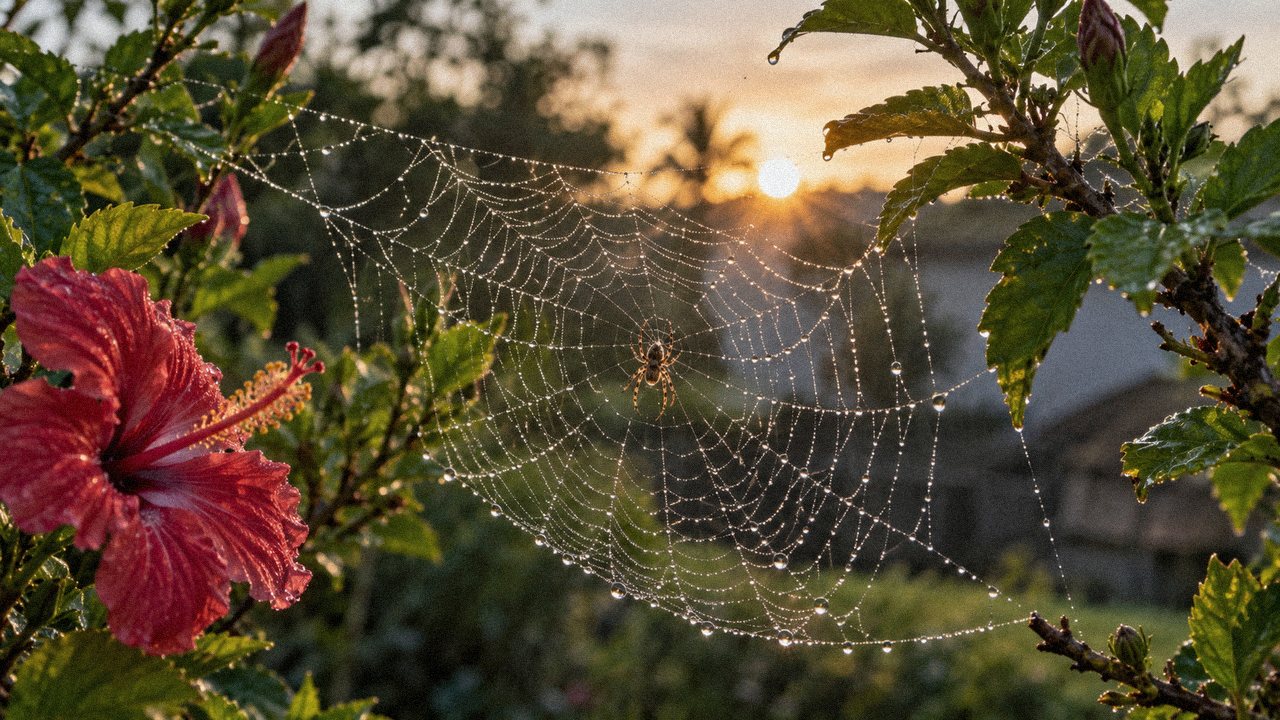
Different spiders build very different webs, and some build none at all. Knowing the main types makes it easy to guess who is living on your eaves or in your garage.
| Web type | What it looks like | Who builds it | Where you find it |
|---|---|---|---|
| Orb web | Flat, round, wheel-like, often with spokes | Garden orb weavers, spiny orb weavers, golden silk spiders, orchard orb weavers | Between shrubs, trees, eaves and porch posts |
| Messy cobweb | Tangled, three-dimensional, no clear pattern | Widow spiders, southern house spiders | Low, sheltered spots: garages, sheds, woodpiles, outdoor furniture, window corners |
| Woolly orb web | Small orb with a fuzzy, woolly look | Hackled orb weavers | Sheltered corners and vegetation |
| Loose, irregular strands | Thin, sparse threads in corners | Cellar spiders (“daddy long legs” spiders) | Ceilings, closets, sheds and attics |
| No capture web | Silk only for egg sacs or safety lines | Wolf spiders, jumping spiders, crab spiders | Floors, walls, gardens and lawns |
That last row matters. If you keep seeing spiders but never find webs, you are probably dealing with hunters such as wolf spiders or jumping spiders, which chase their prey. They often wander indoors from the yard or garage rather than living in the house.
What a Big Golden Web Means
In late summer and fall, many South Florida yards fill with huge yellow webs strung between trees. Those belong to the golden silk spider. According to UF/IFAS, the webs are often 1 to 2 meters across and are semipermanent: the spider repairs sections instead of rebuilding the whole web. The spider is not dangerous, and its bite is much milder than a bee sting.
Is the Web Fresh or Old?
The most useful thing you can learn from a web is whether it is still in use.
- Fresh webs are clean, tight and sticky, often with recently caught insects or a spider sitting in the center or hiding at the edge.
- Old webs sag, collect dust and lint, and hold dried insect remains. These are the classic “cobwebs” in neglected corners. The spider has often moved on or died.
The simplest test is to remove a web and watch the spot. Many orb weavers take down their webs and spin new ones regularly; NC State Extension notes that some species remove the web at the start of each day. If a new web appears in the same spot within a day or two, a spider has decided that location is worth the effort. That usually means insects pass by there often.
Need help with pests in South Florida?
Toro Pest Management has protected homes and businesses since 1969. Get a free inspection and $25 off your first service, backed by our 110% Satisfaction Guarantee: if the pests come back, so do we, at no extra cost.
Why Web Location Matters More Than the Web
Spiders are predators. They do not build where it looks nice; they build where food arrives. That is why the location of a web tells you more than the web itself.
Outside the Home
Outdoors, webs cluster around:
- Porch lights and lit windows. Night-flying insects are drawn to light, and the spiders follow them.
- Doors, garage openings and screens. Insects gather at these entry points, and so do the webs.
- Eaves, soffits and rooflines. These give spiders shelter from rain with a good view of flying prey.
- Shrubs and trees touching the house. Dense plants hold moisture, hide insects and give spiders a bridge to your walls.
- Patio furniture, planters and mailboxes. Sheltered, rarely moved objects suit widow spiders in particular.
Inside the Home
Indoors, spiders prefer quiet, undisturbed areas. The University of Kentucky lists closets, garages, basements and attics as favorite spots, and clutter makes all of them more appealing. In South Florida homes, which rarely have basements, the garage, utility room, storage closets and the spaces behind large furniture fill that role. For a room-by-room list, see common places spiders hide inside your home.
What Multiple Webs Around the House Are Telling You
One web now and then is normal in a warm, green place like South Florida. Fresh webs on several sides of the house, or in several rooms, are different. They tell you that conditions are favorable for spiders over a large area, and since spiders depend on insects, that usually means a steady insect supply.
| What you see | What it likely means | What to do |
|---|---|---|
| One or two webs, rarely rebuilt | Normal outdoor spider activity | Remove them during routine cleaning |
| Webs rebuilt within days at the same lights | Insects are swarming that light at night | Turn lights off when not needed or switch to yellow bulbs |
| Fresh webs in several rooms | Spiders are living and feeding indoors | Vacuum, declutter, look for the insects they eat |
| Messy webs low in the garage or shed | Possible widow spiders | Remove with gloves and a vacuum; reduce clutter |
| Webs with egg sacs | Spiders are breeding on site | Vacuum the sacs and seal the bag |
| Webs full of trapped flies, mosquitoes or gnats | A nearby insect source | Find and fix it: standing water, garbage, open screens |
That last row is often the most revealing. The insects caught in a web show you what is flying around your house. A web full of mosquitoes points to standing water nearby, and our mosquito guide can help you find it. Webs full of small flies can point to drains, garbage or overripe fruit. For more on that link, read why there are more spiders around your home.
Egg Sacs and Widow Webs: When a Web Needs More Care
Most webs around Florida homes belong to harmless spiders. The exception is the messy cobweb of a widow spider. UF/IFAS says widows are the only spiders native to or established in Florida with medically significant venom, and the state has four species: the southern black, northern black, brown and red widow.
Widows build their tangled webs low and in sheltered places. The brown widow, which has spread throughout Florida and builds very close to people, uses plant pots, mailboxes, doorway corners, eaves, garbage can handles and under outdoor chairs, according to UF/IFAS Extension Sarasota County. Its egg sac is the easiest way to recognize it: instead of a smooth, round sac, it is covered with pointed projections, a bit like a tiny spiked ball.
Widows are timid and usually bite only when pressed against skin, for example when a spider hides in a glove, a shoe or an old box. Still, treat their webs with care:
- Wear gloves before reaching into webs under furniture, planters or stored items.
- Vacuum the spider, the web and any egg sacs, then seal the vacuum bag in plastic and throw it out.
- Destroy egg sacs rather than leaving them. The University of Kentucky notes that each sac can hold hundreds of young spiders.
Not sure whether what you found deserves concern? Our guide on when to be concerned about spiders in your home walks through the warning signs.
Should You Remove Spider Webs?
Yes. Removing webs keeps your home looking clean, takes out egg sacs before they hatch and shows you which spots get rebuilt. Use the right tool for the place:
- Indoors: use a vacuum with a hose attachment for corners, ceilings, closets and behind furniture. Empty or seal the bag afterward.
- Eaves and soffits: use an extendable web brush or a soft broom.
- Outdoor furniture, planters and mailboxes: wear gloves, then brush or vacuum.
- Large outdoor orb webs in trees: if they are not in a walkway, you can leave them. Orb weavers catch mosquitoes and other flying insects.
Removing webs alone does not remove the reason the spider chose that spot. If insects keep gathering at a light or slipping through a gap, new webs will appear.
How to Get Fewer Webs Around Your Home
Fewer insects means fewer webs. These steps target both:
- Change the lighting. The University of Kentucky suggests yellow or sodium vapor bulbs at outside entrances because they attract fewer night-flying insects. Turning lights off when you do not need them helps too.
- Trim plants back. Keep shrubs, vines and branches from touching the walls and roof.
- Seal entry points. Fit door sweeps, repair torn screens and seal gaps around windows, pipes and utility lines.
- Declutter. Store items in sealed plastic bins instead of cardboard boxes, especially in the garage.
- Move woodpiles and debris away from the house.
- Fix moisture problems. Leaks and standing water feed the insects that feed the spiders.
When to Call a Professional
Call for an inspection if webs come back within days after cleaning, if you find webs and egg sacs in several rooms, if you see widow spiders around doors, furniture or play areas, or if the insects in the webs suggest a larger pest problem.
Toro’s Total Home Protection Gold 365, part of our residential pest control services, is an every-other-month service inside and outside your home that starts with a 25-point initial service and includes removing spider nests outside the house. Technicians trained at the TORO Institute look for the insects and entry points that keep spiders coming back, and if pests return between visits, so does Toro, at no additional cost to you. To identify the spiders you are seeing, browse our spider pest library.

Contact Toro today
A free inspection & $25 off your first service
A trained Toro technician inspects your home or business, explains what was found and gives you a clear plan and quote, backed by our 110% Satisfaction Guarantee.
305-594-4767Frequently Asked Questions
Are cobwebs a sign of an infestation?
Why do spiders build webs on the same spot every night?
Should I kill the spider or just remove the web?
What spider makes a big golden web in Florida?
Does pressure washing get rid of spider webs for good?
Sources
- An Introduction to Some Common and Charismatic Florida Spiders, UF/IFAS Extension
- Golden Silk Spider, Trichonephila clavipes (Linnaeus) (Arachnida: Araneae: Tetragnathidae), UF/IFAS Extension
- Basilica Orbweaver Spider, NC State Extension
- Brown Widow Spiders, UF/IFAS Extension Sarasota County
- Eliminating Spiders Around Homes and Buildings, University of Kentucky Entomology
- Southern Black Widow, Latrodectus mactans (Fabricius) (Arachnida: Araneae: Theridiidae), UF/IFAS Extension
Educational content. This article is for general information about pests in South Florida and is not medical, legal or professional advice. If you have a bite, sting or allergic reaction, contact your doctor; in an emergency, call 911. Pest problems vary from home to home, so a licensed professional should inspect before treatment. When using any pesticide, always read and follow the product label.


