Key takeaways
- Termites are not carried in by mulch so much as helped by it: thick, wet mulch against the wall hides mud tubes and keeps soil moist.
- UF/IFAS advises mulch under 2 inches thick within 12 inches of the foundation and about a 6-inch visible inspection strip.
- Florida's building code requires irrigation to be at least 1 foot from a building's sidewall, and sprinklers that wet walls can void termite warranties.
- Wood touching soil, from planters to fence posts and landscape timbers, gives subterranean termites a direct path to food.
- Siding, stucco and foam insulation should stop 6 to 8 inches above the soil so termites cannot tunnel up unseen (FDACS).
In this article
- Why Your Yard Matters to Subterranean Termites
- Mulch Piled Against the Foundation
- Irrigation and Drainage That Keep Soil Wet
- Wood Touching the Soil
- Dense Shrubs, Vines and Trees Near the House
- Firewood, Stumps and Yard Debris
- Your Termite-Smart Landscaping Checklist
- When to Call a Professional
- Frequently Asked Questions
Landscaping attracts termites when it gives them what they need right next to your walls: moisture, wood to eat and cover to work unseen. Thick mulch against the foundation, sprinklers that soak the walls, wood touching the soil and shrubs pressed against the house are the most common culprits in South Florida yards.
You do not have to give up a lush tropical yard to lower the risk. Most fixes are about distance, depth and drainage: pulling things a little away from the house, keeping the soil next to it drier and leaving the base of the wall visible. This guide covers each landscaping choice that matters and what to do instead.
Why Your Yard Matters to Subterranean Termites
The termites that respond to landscaping are subterranean species: in South Florida, the native eastern subterranean termite and the invasive Formosan and Asian subterranean termites. They nest in the soil and need moisture to survive, so they forage outward through damp soil and build mud tubes to reach wood above ground. Our guide to subterranean termites and the damage you can’t see explains their biology in depth.
Colonies are large and travel far. UF/IFAS reports that eastern subterranean colonies may hold 100,000 to 1,000,000 termites and forage up to 150 feet. That means termites already living under your lawn or a neighbor’s yard can find the weakest point along your foundation, and landscaping often decides where that weak point is.
South Florida’s climate amplifies every mistake. Summer rains from May through October, heavy irrigation in the dry months and high humidity keep soil damp most of the year. Termites do the rest.
Mulch Piled Against the Foundation
Mulch is the landscaping material homeowners worry about most, and the research gives a more nuanced answer than “mulch causes termites.”
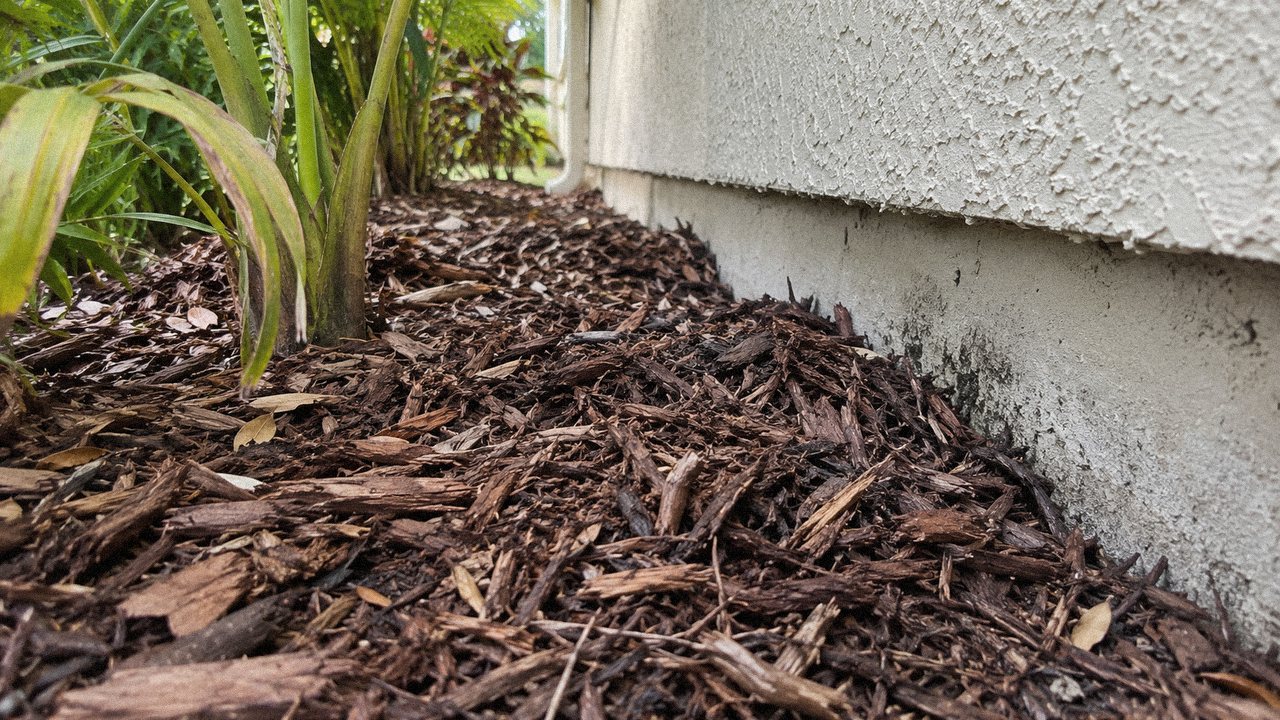
According to UF/IFAS, termites survive poorly in chipped mulch, especially once they are separated from their colony, so bagged mulch is an unlikely way to bring termites home. Established colonies already on the property are a far greater risk. The real problem is how mulch is used next to the house:
- Too thick. Mulch laid more than 4 to 6 inches deep keeps the soil moist and hides the inspection zone.
- Too close. Mulch heaped against the wall lets termites build tubes behind it where nobody sees them.
- Stored on the ground. Piles of mulch sitting on the soil give termites a protected place to feed.
What UF/IFAS recommends: within 12 inches of the foundation, keep any mulch layer under 2 inches thick so the soil underneath can dry, and keep about a 6-inch inspection gap between mulch and the foundation so mud tubes are visible.
Switching to stone is not an automatic fix. In a study cited by UF/IFAS, termites fed more on cardboard under pea gravel than under shredded hardwood bark, pine bark nuggets or eucalyptus bark. Whatever cover you use, keep termite protection in place.
Need help with pests in South Florida?
Toro Pest Management has protected homes and businesses since 1969. Get a free inspection and $25 off your first service, backed by our 110% Satisfaction Guarantee: if the pests come back, so do we, at no extra cost.
Irrigation and Drainage That Keep Soil Wet
Moisture is the most important factor you control. Termites thrive in soil that never dries, and South Florida irrigation systems often spray the same strip along the house several times a week.
- Sprinklers hitting the walls. UF/IFAS notes that Florida’s building code requires irrigation to be at least 1 foot away from a building’s sidewall, and that irrigation wetting the walls is a conducive condition that may void termite warranties.
- Overwatering. Beds watered on a timer during the rainy season stay saturated for days.
- Poor grading. The Florida Department of Agriculture and Consumer Services puts it simply: a house should not sit in a bowl, it should sit on one. Soil should slope away from the structure.
- Downspouts and AC lines that empty right at the foundation. FDACS notes gutters are rarely installed in Florida, but where they exist, they help carry water away from the house.
Adjust spray heads to point away from walls, set controllers for the season and fix leaks in irrigation lines promptly.
Wood Touching the Soil
Any wood in contact with the ground is a bridge from the colony to food. UF/IFAS lists avoiding wood-to-ground contact among its core recommendations, and its fact sheet on native subterranean termites advises keeping structural lumber out of direct contact with soil.
Watch for these common landscape features:
- Wooden borders, edging and landscape timbers around beds
- Fence posts and gates attached to the house
- Pergolas, arbors and trellises set in soil next to walls
- Raised beds and wooden planters against the foundation
- Deck posts and steps resting directly on the ground
Pressure-treated or borate-treated wood resists termites better, but UF/IFAS notes that wood treatment is no guarantee of permanent protection from termite damage. Read can termites eat pressure-treated wood for the details. Wherever possible, set wood on concrete or metal supports and keep a gap between wooden structures and the house.
Dense Shrubs, Vines and Trees Near the House
Plants pressed against a wall shade it, slow drying after rain and hide mud tubes. The EPA advises against planting trees and shrubs too close to a structure, letting them grow against exposed wood or letting plants block foundation vents. UF/IFAS adds that the lower foundation walls and siding should be kept clear of vegetation or mulch so termite tubes are easier to find.
- Shrubs and hedges: plant them so you can walk behind them as they mature, and trim them back from the wall.
- Vines and climbing plants: keep them off walls and wooden trim, which they keep damp and hide.
- Trees: Formosan termites hollow out living trees, eating the dead wood at the center and filling the cavity with carton nest. UF/IFAS warns this weakens trees and raises the risk of collapse in high winds, so trees near the house should be inspected regularly, especially before hurricane season.
Firewood, Stumps and Yard Debris
Stored and buried wood feeds colonies right next to your walls.
- Firewood and lumber: the EPA advises not to pile or store firewood or wood debris next to the house. Store it off the ground and away from the structure.
- Stumps and roots: a stump left near the house can support a colony for years. Grind or remove it if you can, and point it out during inspections. NC State Extension notes that professionals place bait stations closer together around potentially infested items such as stumps.
- Construction scraps: wood buried in the soil during building or remodeling is a hidden food source. Our article on why termites appear even in new homes explains this risk.
- Salvaged timbers: UF/IFAS points to infested railroad ties and salvaged timbers as a more realistic way to bring a viable group of termites home than bagged mulch.
Your Termite-Smart Landscaping Checklist
| Landscape feature | Why it raises termite risk | Better choice |
|---|---|---|
| Mulch against the wall | Keeps soil moist and hides mud tubes | Under 2 inches thick near the house, 6-inch visible strip |
| Sprinklers spraying walls | Wet foundation soil; can void warranties | Heads aimed away, at least 1 foot from the sidewall |
| Soil sloping toward the house | Water collects at the foundation | Regrade so soil slopes away |
| Siding or stucco below grade | Termites tunnel up behind it unseen | Stop it 6 to 8 inches above soil (FDACS) |
| Wood touching soil | Direct path from colony to food | Concrete or metal supports, gap from the house |
| Shrubs and vines on walls | Shade, moisture and cover for tubes | Plant and trim so you can walk behind them |
| Firewood and debris piles | Food and shelter next to the house | Store off the ground, away from the structure |
| Stumps and buried wood | Hidden food that supports colonies | Remove or grind; tell your inspector |
Several of these conditions often appear together, which is exactly what our list of 6 things you could be doing to attract termites warns about: moist soil, organic cover and wood all within a few inches of the wall.
When to Call a Professional
Good landscaping makes your home less inviting and easier to inspect, but it does not remove colonies already in the soil. Call for an inspection if you notice mud tubes along the foundation, swarmers or discarded wings near doors and windows, wood that sounds hollow or soft trim near planted beds. Plan one before major landscape work, too, so existing protection is not disturbed. Our article on how often you should get a termite inspection covers the right schedule.
Toro’s free inspection looks at the conditions around your home as well as the structure itself: mulch depth, irrigation, grading, wood contact and the trees nearest the house. A trained technician identifies any termites present and recommends the right protection through our termite control service, from Sentricon bait stations installed around the property for subterranean termites to prevention for homes that are not infested yet. Toro has protected South Florida homes since 1969, and if the bugs come back, so will Toro, at no additional cost to you.

Contact Toro today
A free inspection & $25 off your first service
A trained Toro technician inspects your home or business, explains what was found and gives you a clear plan and quote, backed by our 110% Satisfaction Guarantee.
305-594-4767Frequently Asked Questions
Does mulch attract termites?
Is rock or rubber mulch better for termites than wood mulch?
Should I remove shrubs growing against my house?
Can a tree stump near my house cause termites?
Do termite treatments still work if I redo my landscaping?
Sources
- The Facts About Termites and Mulch (EDIS IN651), UF/IFAS Extension
- Protecting Yourself and Your Property Against Subterranean Termites, Florida Department of Agriculture and Consumer Services
- Termites: How to Identify and Control Them, U.S. Environmental Protection Agency
- Native Subterranean Termites (EDIS IN369), UF/IFAS Extension
- Formosan Subterranean Termite, Coptotermes formosanus (EDIS IN278), UF/IFAS Extension
- Termite Baiting Systems, NC State Extension
Educational content. This article is for general information about pests in South Florida and is not medical, legal or professional advice. If you have a bite, sting or allergic reaction, contact your doctor; in an emergency, call 911. Pest problems vary from home to home, so a licensed professional should inspect before treatment. When using any pesticide, always read and follow the product label.


