
Key takeaways
- Three whiteflies drive most South Florida landscape damage: ficus whitefly, rugose spiraling whitefly and silverleaf whitefly.
- Rugose spiraling whitefly has more than 60 recorded host plants, including gumbo limbo, coconut palm, avocado and black olive (FDACS).
- The ficus whitefly alone will not typically kill a hedge, but combined with drought, over-pruning or poor fertilization it can cause severe dieback (UF/IFAS).
- Most bare ficus hedges grow new leaves once whiteflies are controlled, so replacement is not the first step.
In this article
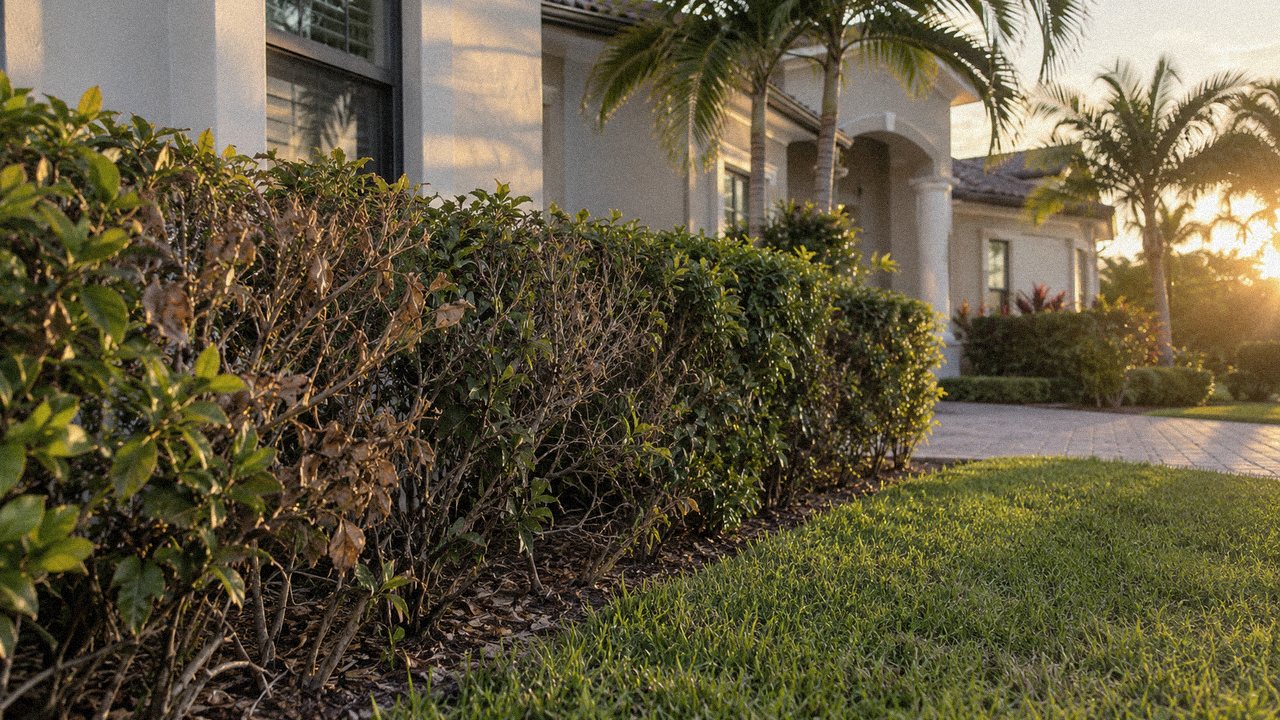
Whiteflies threaten your landscape by draining sap from the plants that frame a South Florida property: ficus hedges, palms, shade trees and flowering shrubs. The result is yellow leaves, bare branches and a black, sticky film on everything below, and that visible decline is what costs you curb appeal and, if you sell, buyer interest.
The damage is rarely sudden. It builds for months on the undersides of leaves, where you do not look. This guide covers which whiteflies matter here, which plants in your yard are most at risk, how the damage affects the value of a landscape and what protects it.
The Whiteflies Behind South Florida Landscape Damage
There are more than 75 whitefly species in Florida, according to UF/IFAS Extension in Palm Beach County, but only a few cause serious landscape problems. They differ a lot in what they eat.
| Whitefly | Main landscape targets | What you notice | First found in Florida |
|---|---|---|---|
| Ficus whitefly | Weeping fig and banyan hedges and trees | Yellow leaves, then a bare hedge | 2007, Miami-Dade |
| Rugose spiraling whitefly | Gumbo limbo, coconut and adonidia palms, black olive, avocado | White waxy spirals, heavy sooty mold | 2009, Miami-Dade |
| Silverleaf whitefly | Hibiscus in landscapes; also vegetables | Clouds of tiny adults, sticky leaves | Long established |
| Bondar’s nesting whitefly | Ficus, hibiscus, guava, citrus, coconut | Round white wax “nests” on black mold | 2011 |
Host range is the key difference. A pest that feeds on one plant group is easy to plan around; one that feeds on dozens can move through an entire yard.
Source: UF/IFAS Extension Palm Beach County; FDACS; UF/IFAS EDIS IN1169
The ficus whitefly attacks only ficus, but it has been reported on at least eleven ficus species, and Ficus benjamina, the weeping fig, is its preferred host in Florida, according to UF/IFAS. That is the same plant chosen for countless privacy hedges because it is inexpensive, fast-growing and tolerates heavy pruning. The rugose spiraling whitefly, by contrast, has more than 60 recorded hosts, according to the Florida Department of Agriculture and Consumer Services.
Which Plants in Your Yard Are Most at Risk?
Walk your property with this list in mind:
- Ficus hedges and trees. The classic South Florida privacy screen and the most common whitefly casualty.
- Palms. Coconut and adonidia palms are among the rugose spiraling whitefly’s favorite hosts.
- Shade and fruit trees. Gumbo limbo, black olive, Calophyllum and avocado are among the most seriously affected hosts, and mango is attacked too. Our guide to what whiteflies are doing to your trees covers trees in depth.
- Flowering shrubs. Hibiscus attracts silverleaf and Bondar’s nesting whiteflies.
Not every ficus is at the same risk. UF/IFAS lists Green Island ficus, Ficus religiosa, edible fig, fiddle leaf fig and creeping fig among the ficus not known to be affected by the ficus whitefly.
Need help with pests in South Florida?
Toro Pest Management has protected homes and businesses since 1969. Get a free inspection and $25 off your first service, backed by our 110% Satisfaction Guarantee: if the pests come back, so do we, at no extra cost.
How Whiteflies Damage a Landscape
Whiteflies feed with piercing-sucking mouthparts on the undersides of leaves. UF/IFAS explains that infestations often go unnoticed until leaves yellow or drop, or until a disturbed plant releases a cloud of adults. By then, the damage has layers:
Leaf Loss and Thinning
Ficus leaves turn yellow before they drop, and a hedge can thin until you see straight through it. The UF/IFAS Tropical Research and Education Center notes that if you have defoliation, you have had the whitefly for numerous months.
Honeydew and Sooty Mold
Whiteflies excrete sugary honeydew. Black sooty mold grows on it, and UF/IFAS says sooty mold may reduce photosynthesis, slow growth and cause early leaf drop. Honeydew also drips onto cars, pavers and patio furniture. For cleanup and diagnosis, see why your hedge is turning black.
Wax and Debris
FDACS reports that rugose spiraling whitefly honeydew, wax and dead adults fall on cars, patios and furniture and can clog pool filters, and that sooty mold attracts stinging ants and honeydew wasps.
Branch Dieback
Dieback varies from plant to plant and is linked to the plant’s overall health. Stressed hedges lose whole sections.
What Whitefly Damage Means for Property Value
Landscaping is part of what a buyer, tenant or customer sees first. A full ficus hedge reads as privacy and good upkeep; a bare, black-stained one reads as neglect and an expense the next owner will inherit. Whiteflies do not harm the structure of a home, but they can make a well-kept property look like a project.
The bigger financial risk is overreacting or underreacting:
- Ripping out recoverable plants. UF/IFAS reports that in most cases trees and hedges grow new leaves once the whitefly is under control. Mature hedges take years to replace at the same height.
- Waiting too long. The longer a hedge stays bare, the more its reserves run down, and a plant already stressed by drought or heavy shearing is the one most likely to die back.
- Ignoring hardscape cleanup. Honeydew, wax and sooty mold build up on pavers, cars and outdoor furniture, so wash them regularly during an infestation instead of letting stains set.
If you manage an HOA or rental property, the same math applies across many lots: see how whiteflies impact HOA communities. For a closer look at the costs of delay, read why ignoring whiteflies can cost you more.
How to Protect Your Landscape Investment
You cannot keep whiteflies out of South Florida, but healthy, well-managed plants tolerate them far better.
Reduce Plant Stress
UF/IFAS Extension in Palm Beach County lists freezing temperatures, rapid temperature changes, poor fertilization, over-pruning and improper watering as common stresses on ficus. Its fact sheet notes that the ficus whitefly alone will not typically kill hedges, but combined with other stress it can cause severe dieback or death.
- Water no more than about 1 inch per week; both drought and overwatering stress plants.
- Fertilize regularly, since South Florida’s sandy soils are low in nutrients.
- Shear less often so the plant keeps more leaves to make energy.
Scout Early
Check the undersides of ficus leaves and palm fronds every few weeks. Look for eggs, flat nymphs, white wax spirals and sticky leaves. Our guide to whitefly signs of infestation shows what to look for.
Diversify New Plantings
When you replace dead plants, mix species instead of planting one long row of the same shrub. A diverse landscape limits how far any one whitefly can spread.
Keep Hardscape and Outdoor Areas Clean
Honeydew, wax and sooty mold collect on pavers, pool decks, screens and furniture under infested plants, and FDACS notes that rugose spiraling whitefly debris can even clog pool filters. Rinse these surfaces regularly while an infestation is being treated. Clean hardscape keeps the property looking cared for while the plants recover, and it makes it easier to see whether new honeydew is still falling.
Protect the Natural Enemies
Tiny parasitic wasps and lady beetles attack whiteflies in South Florida landscapes. UF/IFAS warns that insecticides can be severely detrimental to these parasitoids, so avoid broad sprays that wipe them out along with the pest.
When to Bring in a Professional
Call for an inspection when hedges are thinning, leaves are sticky or black, or palms show white spirals under the fronds. Treatment choice depends on the species, the plant and its size, and systemic treatments for trees and hedges are typically applied to the soil or trunk.
Toro’s whitefly control service starts with a free inspection of your ficus hedges, palms and trees, including the undersides of the leaves, to identify which whitefly you have and how heavy the infestation is. You get a plan and a quote before work begins, and we check your ficus for early signs of new whiteflies after treatment. For lawn insects such as chinch bugs that stress the rest of your yard, see our lawn spray service.

Contact Toro today
A free inspection & $25 off your first service
A trained Toro technician inspects your home or business, explains what was found and gives you a clear plan and quote, backed by our 110% Satisfaction Guarantee.
305-594-4767Frequently Asked Questions
Do whiteflies lower home values?
Which landscape plants do whiteflies attack most in South Florida?
Should I replace my ficus hedge with something else?
How long does a landscape take to recover from whiteflies?
Can whiteflies spread from my neighbor's yard?
Sources
- Whiteflies on Landscape Ornamentals, UF/IFAS Extension
- The Rugose Spiraling Whitefly, Aleurodicus rugioperculatus Martin, a New Exotic Whitefly in South Florida (Hemiptera: Aleyrodidae), Florida Department of Agriculture and Consumer Services
- Whiteflies in Palm Beach County ~ Introduction, UF/IFAS Extension Palm Beach County
- Ficus Whitefly Management in the Landscape, UF/IFAS Tropical Research and Education Center
- Whiteflies in Palm Beach County ~ Reducing Stress on Plants, UF/IFAS Extension Palm Beach County
- Balios Eulophid Baeoentedon balios Wang, Huang & Polaszek (Insecta: Hymenoptera: Eulophidae), UF/IFAS Extension
Educational content. This article is for general information about pests in South Florida and is not medical, legal or professional advice. If you have a bite, sting or allergic reaction, contact your doctor; in an emergency, call 911. Pest problems vary from home to home, so a licensed professional should inspect before treatment. When using any pesticide, always read and follow the product label.


