Key takeaways
- Rats and mice are the bigger day-to-day threat inside a home: they chew wiring, contaminate food and can spread diseases such as leptospirosis and salmonellosis.
- Exotic species do more damage outdoors and to native wildlife: iguana burrows can collapse seawalls and sidewalks, and Cuban treefrogs eat native frogs.
- Green iguanas cannot be relocated in Florida, and no government program removes Cuban treefrogs, so control falls to property owners.
- Never handle a giant African land snail barehanded; it can carry a parasite that causes meningitis. Report sightings to FDACS.
In this article
For most South Florida homeowners, rodents are the worse pest: rats and mice get inside, chew wiring, contaminate food and can spread disease, all while hidden in the attic or walls. Exotic pests such as green iguanas, Cuban treefrogs and giant African land snails usually do their damage outdoors, to seawalls, landscaping, plumbing vents and native wildlife.
That does not make exotic pests harmless. Some carry their own health risks, and Florida law limits what you can do with them. The real answer depends on where the pest is, what it is damaging and how fast you act. This guide compares both groups side by side so you can decide what needs attention first.
Why South Florida Has Both Problems
South Florida’s warm, humid climate lets pests stay active all year. There is no hard winter to knock populations back, and the rainy season fills yards with food, water and dense growth.
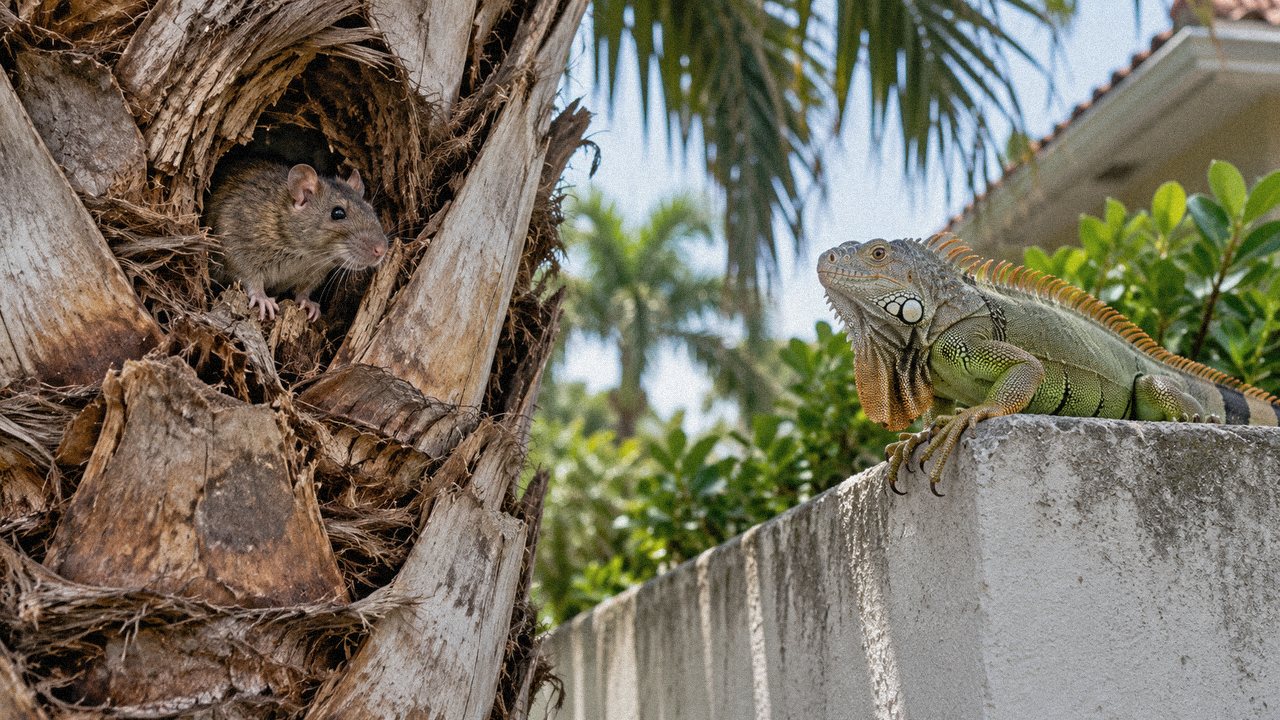
Rodents thrive here because homes give them everything they need. According to UF/IFAS, roof rats thrive in attics, roof spaces, palm trees and ornamental shrubs, while Norway rats are most common along sea coasts and canals. Both describe much of Miami-Dade, Broward, Palm Beach and the Keys.
Exotic species arrive with people. The Cuban treefrog likely reached the Florida Keys as a stowaway in shipping crates in the 1920s, according to UF/IFAS. Green iguanas were first reported in Miami-Dade in the 1960s, and FWC notes that South Florida’s canals act as corridors that help them spread. Once here, few cold snaps and abundant food let them settle in.
Rodents: The Pest That Moves In With You
Three rodents cause most problems in South Florida homes: the roof rat, the Norway rat and the house mouse. What makes them so hard to live with is that they share your space.
How Fast Rodents Multiply
UF/IFAS figures show how quickly a few rodents become many:
- Roof rats reach maturity in 3 to 5 months and have 6 to 8 young per litter, up to 6 litters a year.
- Norway rats have 8 to 12 young per litter, up to 7 litters a year.
- House mice mature in about 6 weeks and have 5 to 6 young per litter, up to 8 litters a year.
What Rodents Damage
- Wiring: Roof rats gnaw electrical wires and rafters in attics, a hazard covered in our article on rodents and electrical fires.
- Food: Rodents contaminate about 10 times as much food as they eat, through urine, droppings and hair (UF/IFAS).
- Structures: Norway rats burrow under slabs and can undermine foundations, erode banks and block sewer lines.
- Landscapes: Roof rats gnaw fruit on trees and are destructive in citrus.
Health Risks of Rats and Mice
The CDC lists several diseases rodents can spread directly, including leptospirosis, salmonellosis, rat-bite fever and hantavirus. People can be exposed by touching droppings, urine or saliva, by breathing contaminated air, by eating contaminated food or through bites and scratches. Our guide to the hidden dangers of rodent droppings explains how to clean up safely.
Need help with pests in South Florida?
Toro Pest Management has protected homes and businesses since 1969. Get a free inspection and $25 off your first service, backed by our 110% Satisfaction Guarantee: if the pests come back, so do we, at no extra cost.
Exotic Pests: Outdoor Damage and Ecological Harm
Many non-native animals are established in South Florida. Three of them show up most often in homeowners’ questions.
Green Iguanas
FWC classifies the green iguana as invasive. According to FWC, iguanas:
- Eat residential and commercial landscape plants
- Dig burrows that can erode and collapse sidewalks, foundations, seawalls, berms and canal banks
- Leave droppings on docks, boats, porches, pool decks and inside pools
- Can spread Salmonella to people through water or surfaces contaminated with their feces
They also eat native tree snails and nickerbean, a host plant of the endangered Miami blue butterfly. For more on the health side, read do iguanas carry disease.
Cuban Treefrogs
The Cuban treefrog is big for a treefrog; UF/IFAS says any Florida treefrog over 3 inches is almost certainly this species. It eats native treefrogs, and its tadpoles outcompete native tadpoles. Around homes, UF/IFAS reports that Cuban treefrogs:
- Hide behind storm shutters and siding and leave droppings on lit walls and windows
- Enter plumbing through roof vent pipes, sometimes ending up in toilets, and have clogged sink drains
- Invade transformer boxes and switches, causing short circuits and occasional power outages
- Produce skin secretions that irritate the eyes and nose for over an hour; pets that bite them may drool heavily, and seizures have been reported
No university or government program removes Cuban treefrogs, so management is up to each property owner.
Giant African Land Snails
The giant African land snail can reach about 8 inches long and eats more than 500 types of plants. The Florida Museum of Natural History notes it can chew through paint and stucco on buildings, and it can carry the parasite that causes meningitis in people and animals. Florida eradicated a South Florida infestation in 2021 after about a decade of work, but the snail was found again in Pasco County in 2022. Report any sighting to the FDACS hotline at 1-888-397-1517.
Invasive ants such as ghost ants are another exotic group, but they behave more like an indoor household pest and are handled with general pest control.
Rodents vs. Exotic Pests: Side-by-Side Comparison
| Factor | Rats and mice | Green iguanas | Cuban treefrogs | Giant African land snails |
|---|---|---|---|---|
| Where they cause trouble | Inside attics, walls, kitchens, garages | Yards, seawalls, docks, pools | Shutters, vent pipes, drains, utility boxes | Gardens, landscapes, stucco walls |
| Main health concern | Leptospirosis, salmonellosis, hantavirus, rat-bite fever | Salmonella from droppings | Skin secretions irritate eyes and nose | Parasite that causes meningitis |
| Property damage | Chewed wires, insulation, food, pipes | Collapsed seawalls, sidewalks, banks; eaten plants | Clogged drains, short circuits | Eaten plants, chewed stucco |
| Harm to native wildlife | On Key Largo, black rats may compete with the endangered Key Largo cotton mouse (FWC) | Eat tree snails and butterfly host plants | Eat native frogs | Major agricultural and biodiversity pest |
| Legal limits | Standard pest control; follow rodenticide labels | Cannot be relocated; humane killing only | Use humane methods only (UF/IFAS) | State eradication program; report sightings |
| Who handles it | Licensed pest control | Wildlife control professional | Property owner | FDACS |
So, Which Is Worse?
It depends on what you are protecting.
Inside your home, rodents win. They live where you sleep and eat, contaminate food and surfaces, damage wiring and multiply faster than most people expect. A rodent problem rarely stays small, and it keeps getting more expensive the longer it runs.
Outside your home, exotic pests can be worse. Iguanas burrowing along a canal can undermine a seawall, a repair on a very different scale from an attic cleanup, and Cuban treefrogs and giant snails cause problems no trap in the attic will solve. They also do lasting harm to native wildlife, which is why state agencies treat them as invasive.
The worst case is having both. A yard with fruit trees, dense shrubs, open water and clutter can feed roof rats, shelter iguanas and breed Cuban treefrogs at the same time. Fixing those conditions helps against all of them.
How to Protect Your Property From Both
Many of the same steps work against rodents and exotic species:
- Trim trees and vines so branches do not touch the roof, and keep palms free of old frond skirts where roof rats nest.
- Pick up fallen fruit and do not leave pet food or bird seed outside overnight.
- Seal openings. Rats fit through gaps about 1/2 inch wide and mice through about 1/4 inch, so close gaps around pipes, vents and eaves with hardware cloth, sheet metal or concrete (UF/IFAS).
- Cover roof vent pipes with hardware cloth to keep Cuban treefrogs out of plumbing.
- Remove standing water in buckets, birdbaths and coolers, which Cuban treefrogs use for breeding.
- Use yellow bug lights and turn off unneeded outdoor lights to attract fewer frogs.
- Fill iguana holes and remove the plants iguanas favor; for more ideas, see how to keep iguanas away from your yard.
When to Call a Professional
Call a professional when you hear scratching in the attic, find droppings or gnaw marks indoors, or see burrows forming along a seawall or slab. These problems spread quickly and are hard to fix with store-bought products alone.
Toro’s rodent control service starts with a free inspection to identify which rodents you have, where they nest and every gap they use to get in. Technicians remove the rodents with trapping and baiting chosen for your property, seal the entry points and offer dropping and urine disinfecting and sanitation. For iguanas, raccoons and opossums in Miami-Dade, Toro’s wildlife team traps and removes animals by humane methods allowed under FWC rules. Toro has protected South Florida homes and businesses since 1969, and if the bugs come back, so will Toro, at no additional cost to you.

Contact Toro today
A free inspection & $25 off your first service
A trained Toro technician inspects your home or business, explains what was found and gives you a clear plan and quote, backed by our 110% Satisfaction Guarantee.
305-594-4767Frequently Asked Questions
Are iguanas more dangerous than rats?
Can I kill an iguana on my property in Florida?
Do Cuban treefrogs damage houses?
What attracts rats to South Florida neighborhoods?
What should I do if I see a giant African land snail?
Sources
- Rat and Mouse Control (EDIS ENY-224), UF/IFAS Extension
- Controlling Wild Rodent Infestations, Centers for Disease Control and Prevention
- Green Iguana, Florida Fish and Wildlife Conservation Commission
- The Cuban Treefrog in Florida (EDIS UW259), UF/IFAS Extension
- Key Largo Cotton Mouse, Florida Fish and Wildlife Conservation Commission
- Tell Me About: Giant African Land Snail, Florida Museum of Natural History
Educational content. This article is for general information about pests in South Florida and is not medical, legal or professional advice. If you have a bite, sting or allergic reaction, contact your doctor; in an emergency, call 911. Pest problems vary from home to home, so a licensed professional should inspect before treatment. When using any pesticide, always read and follow the product label.