
Key takeaways
- Drywood termites live inside the wood they eat and need no soil contact; subterranean termites nest in moist soil and reach wood through mud tubes.
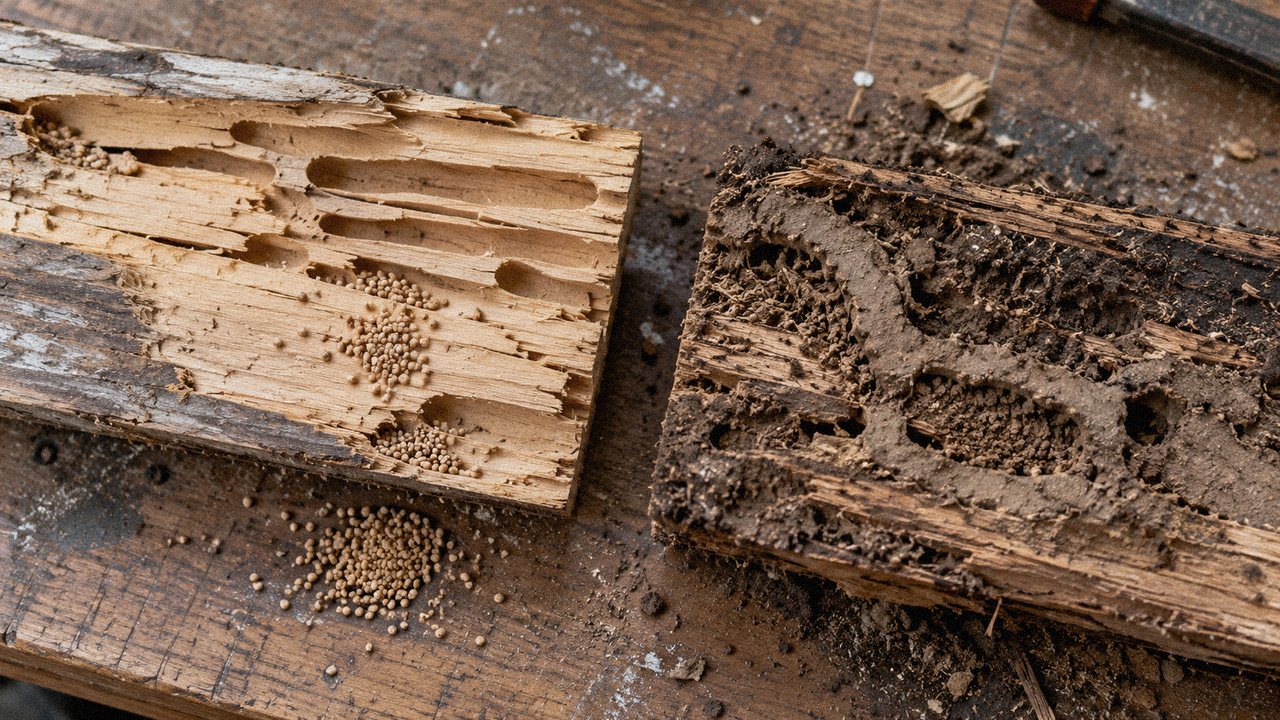
- Hard, six-sided pellets piling up below wood point to drywood termites; mud tubes and soil in galleries point to subterranean termites.
- Tenting works for drywood termites spread through a structure, but UF/IFAS says it is useless against subterranean termites.
- Subterranean termites are controlled with baits or soil termiticides; localized drywood colonies can often be spot-treated.
- Most South Florida termite swarms happen from late winter to early summer, and each species has its own flight window.
In this article
- Drywood vs. Subterranean Termites at a Glance
- What Are Drywood Termites?
- What Are Subterranean Termites?
- How to Tell Them Apart by Their Swarms
- Why Knowing the Difference Matters for Treatment
- The Cost of Getting It Wrong
- Prevention Tips for Each Type
- How Toro Identifies and Treats Your Termites
- Frequently Asked Questions
The main difference is where they live. Drywood termites live entirely inside dry wood, such as rafters, trim and furniture, and never need soil. Subterranean termites live in moist soil, travel to your home through mud tubes and eat structural wood from the inside out.
That one difference changes everything else: the signs you look for, how fast the damage grows and, above all, the treatment. Tenting a house kills drywood termites in the wood, but it does nothing to a subterranean colony living in the ground. South Florida has both groups, often on the same street, so knowing which one you are dealing with is the first step to fixing the problem.
Drywood vs. Subterranean Termites at a Glance
| Feature | Drywood termites | Subterranean termites |
|---|---|---|
| Where the colony lives | Inside dry, sound wood above ground | In moist soil or hidden damp cavities |
| Needs soil contact | No; gets water from the wood | Yes; needs constant moisture |
| Colony size | Small; some colonies live in a single piece of wood | Large: 100,000 to 1,000,000 for eastern subterranean, several million for Formosan |
| Main visible sign | Piles of hard, six-sided pellets | Mud tubes on foundations and walls |
| Galleries | Clean and smooth, no soil | Often lined or packed with soil |
| South Florida species | West Indian drywood termite and others | Formosan, Asian and eastern subterranean termites |
| Typical treatments | Spot treatment or tent fumigation | Baits or soil-applied termiticides |
| Does tenting work? | Yes, for widespread infestations | No |
Florida has 20 established termite species, according to UF/IFAS, but most structural damage in South Florida comes from a handful: the West Indian drywood termite and the Formosan, Asian and eastern subterranean termites. Our termite pest library has photos and profiles of each.
What Are Drywood Termites?
Drywood termites nest in the wood they eat. They do not tunnel to the ground and do not build mud tubes, because they get the moisture they need from the wood itself. That lets them live in attic framing, window and door frames, baseboards, cabinets and wooden furniture far from any soil.
The West Indian drywood termite is the most important one in South Florida. UF/IFAS notes it was first recorded in Florida in 1918, in a Key West building, and that its largest populations are in older buildings in the southern half of the state. Its colonies start producing winged reproductives at about five years of age and can live more than ten years.
Signs of Drywood Termites
- Fecal pellets. Workers push their droppings out through tiny kick-out holes, typically 1 to 2 mm across. The hard pellets have six flattened sides and pile up below the hole.
- Blistered paint or thin wood. Galleries can leave only a paper-thin layer of wood or paint on the surface.
- Swarmers and wings near windows and lights, mostly in spring.
Drywood damage builds slowly, but it builds in many places. Because these termites are easily carried in wooden items, a single piece of infested furniture or trim can bring a colony into a home. See how drywood termites sneak in through furniture and wood trim and why drywood damage is so hard to spot.
Need help with pests in South Florida?
Toro Pest Management has protected homes and businesses since 1969. Get a free inspection and $25 off your first service, backed by our 110% Satisfaction Guarantee: if the pests come back, so do we, at no extra cost.
What Are Subterranean Termites?
Subterranean termites need moisture to survive, so their colonies live in the soil. Workers forage outward for wood and other cellulose and build shelter tubes of soil and saliva to cross foundations and walls without drying out or meeting predators.
Their colonies are much larger than drywood colonies. UF/IFAS reports that a colony of the native eastern subterranean termite may hold 100,000 to 1,000,000 termites and forage up to 150 feet for food. The invasive Formosan subterranean termite forms colonies of several million and has been recorded foraging up to about 100 meters in the field. The Asian subterranean termite, first found in Miami in 1996, is established from the Keys to Palm Beach County, and a 2026 University of Florida study found it as far north as Brevard and Hillsborough counties. It can cause severe damage in a relatively short time when a large colony invades a building.
Signs of Subterranean Termites
- Mud tubes running up the foundation, slab edges, block walls or garage walls
- Swarmers or piles of wings around doors, windows and light fixtures
- Hollow-sounding wood or wood a screwdriver sinks into easily
- Galleries with soil inside when damaged wood is opened
- Carton nest material in wall voids or hollow trees (Formosan and Asian termites)
For the full picture of how these termites work and the damage they cause, read our guide to subterranean termites and their hidden damage.
How to Tell Them Apart by Their Swarms
Winged termites, called swarmers or alates, leave mature colonies to pair off and start new ones. In South Florida, most of these flights happen between late winter and early summer, but each species has its own window, and subterranean species each fly at a typical time of day.
active peak
Source: UF/IFAS EDIS (IN236, IN278, IN285, IN369)
- Eastern subterranean termites fly on warm, sunny, windless early afternoons, usually after rain.
- Asian subterranean termites fly at dusk or at night, from about February to April.
- Formosan subterranean termites swarm shortly after sunset, from early April to late June, peaking in May.
- West Indian drywood termites fly mainly from April to June, although UF/IFAS notes flights are possible at any time of year.
Swarmers of every species are drawn to lights, so they often end up on windowsills. A few indoors do not always mean your home is infested, but UF/IFAS says hundreds to thousands of swarmers indoors usually indicate a structural infestation. Before blaming termites, rule out flying ants with our guide to termites vs. flying ants.
Why Knowing the Difference Matters for Treatment
The biggest reason to identify the termite correctly is that the treatments do not overlap. UF/IFAS stresses that termite treatments differ depending on the type you have.
Treating Drywood Termites
- Spot treatments. When a colony is localized and accessible, insecticide can be injected into the galleries through drilled holes or kick-out holes. Borate or insecticide sprays and foams can also be applied to exposed wood.
- Tent fumigation. When colonies are spread through the structure or hidden in walls, UF/IFAS calls tenting the most cost-effective solution. The gas reaches all the wood in the building at once.
- Compartment heat. Heaters can treat a single room or apartment, though whole-house heat treatment is rarely used.
Our article on fumigation myths covers what tenting does and does not do.
Treating Subterranean Termites
- Termite baits. Stations in the soil around the building hold a slow-acting bait that workers share with the colony. UF/IFAS notes that eliminating a Formosan colony with baits takes about three months.
- Liquid termiticides. Non-repellent products applied to the soil around and under the structure keep termites out of the treated zone, but they may not eliminate colonies nearby.
Tenting is the wrong tool here. In the words of a UF/IFAS termite scientist, fumigation is useless for subterranean termites, because the rest of the colony can move right back in after the tent comes off.
The Cost of Getting It Wrong
Misidentification wastes money and time while the termites keep eating.
- Treating the soil for drywood termites misses colonies living high in the framing, trim and furniture.
- Spot-treating a few boards for subterranean termites kills some workers but leaves a colony of hundreds of thousands or millions in the ground, ready to send more.
- Tenting for subterranean termites clears the house for a few days and leaves the colony untouched.
- Assuming all damage is from one species can leave a second infestation untreated, since a home can host drywood and subterranean termites at the same time.
Prevention Tips for Each Type
Some prevention steps help with both, and some are specific to one group.
For drywood termites:
- Inspect secondhand wooden furniture, antiques and frames for pellets and small holes before bringing them inside.
- Keep paint and sealant on exposed wood in good condition.
- Screen attic vents; UF/IFAS notes that fine mesh can help keep swarmers out, though complete exclusion is almost impossible.
- Watch windowsills and the floor below wooden furniture for new pellets.
For subterranean termites:
- Fix leaking pipes, AC condensate lines and roof leaks promptly.
- Keep structural wood out of contact with soil.
- Keep mulch and plants off the foundation and siding so mud tubes stay visible.
- Aim sprinklers away from walls and make sure rainwater drains away from the house.
For both: schedule an annual termite inspection. In South Florida’s warm, humid climate, termites stay active all year, and a trained eye catches early signs that homeowners usually miss.
How Toro Identifies and Treats Your Termites
Toro’s termite control service starts with a free inspection. A trained technician identifies the species, checks how far the damage goes and then recommends the treatment that fits:
- Subterranean termites (Formosan, Asian and eastern): the Sentricon baiting system, installed in the soil around the property with no drilling into the slab and no trenches. Termites carry the bait back to the colony, which is designed to eliminate it, including the queen, and the stations stay in place for year-round protection.
- Localized drywood termites: TORO-GUARD, a non-tenting injection treatment, so you do not have to leave your home.
- Drywood termites spread through the structure: tent fumigation, which treats all the wood at once, including walls, trim and furniture.
Toro has protected homes and businesses in Miami-Dade, Broward, Palm Beach and the Keys since 1969, with technicians trained at the TORO Institute alongside on-staff entomologists. If the bugs come back, so will Toro, at no additional cost to you.

Contact Toro today
A free inspection & $25 off your first service
A trained Toro technician inspects your home or business, explains what was found and gives you a clear plan and quote, backed by our 110% Satisfaction Guarantee.
305-594-4767Frequently Asked Questions
Which is worse, drywood or subterranean termites?
Can you have drywood and subterranean termites at the same time?
What do drywood termite droppings look like?
Do mud tubes always mean subterranean termites?
How can I find out which termites I have?
Sources
- West Indian Drywood Termite, Cryptotermes brevis (EDIS IN236), UF/IFAS Extension
- Native Subterranean Termites: Reticulitermes flavipes, R. virginicus, R. hageni (EDIS IN369), UF/IFAS Extension
- Formosan Subterranean Termite, Coptotermes formosanus (EDIS IN278), UF/IFAS Extension
- Asian Subterranean Termite, Coptotermes gestroi (EDIS IN285), UF/IFAS Extension
- Termite Season: UF/IFAS Scientist Answers Common Questions, Corrects Misconceptions, UF/IFAS News
- New Study Shows Invasive Termites Threatening Homes in Florida Are Spreading Farther Than Predicted, University of Florida News
Educational content. This article is for general information about pests in South Florida and is not medical, legal or professional advice. If you have a bite, sting or allergic reaction, contact your doctor; in an emergency, call 911. Pest problems vary from home to home, so a licensed professional should inspect before treatment. When using any pesticide, always read and follow the product label.


