
Key takeaways
- The eastern subterranean termite is a native species found statewide in Florida; one colony can hold 100,000 to 1,000,000 termites.
- Its swarmers are dark brown to nearly black and fly on warm, sunny early afternoons, usually after rain, from about January to April.
- Pencil-width mud tubes on the foundation, slab cracks or plumbing penetrations are the most reliable sign.
- Termites eat the soft springwood and leave the surface intact, so tap suspect wood with a screwdriver handle to find hollow spots.
- Do not break or spray what you find: photograph it, save a few insects and get a licensed inspection.
In this article
- What Is the Eastern Subterranean Termite?
- Sign 1: Daytime Swarms in Late Winter and Spring
- Sign 2: Mud Tubes on the Foundation
- Sign 3: Discarded Wings Near Windows, Sinks and Tubs
- Sign 4: Hollow, Blistered or Soft Wood
- How to Tell Eastern Subterranean Termites From Formosan and Asian Termites
- Signs That Point to Something Else
- What to Do When You Find Signs
- Frequently Asked Questions
The clearest signs of an eastern subterranean termite infestation are pencil-width mud tubes on your foundation, dark swarmers or piles of shed wings near windows in late winter and spring, and wood that sounds hollow or looks blistered. Because the termites stay hidden inside the wood, these clues are usually all you will see until the damage is advanced.
The eastern subterranean termite is one of Florida’s most widespread native termites, and in Miami-Dade, Broward and Palm Beach it shares the ground with two invasive relatives that look and behave differently. This guide walks through each sign specifically for the eastern species, shows how to tell it from Formosan and Asian subterranean termites, and explains what to do once you find evidence.
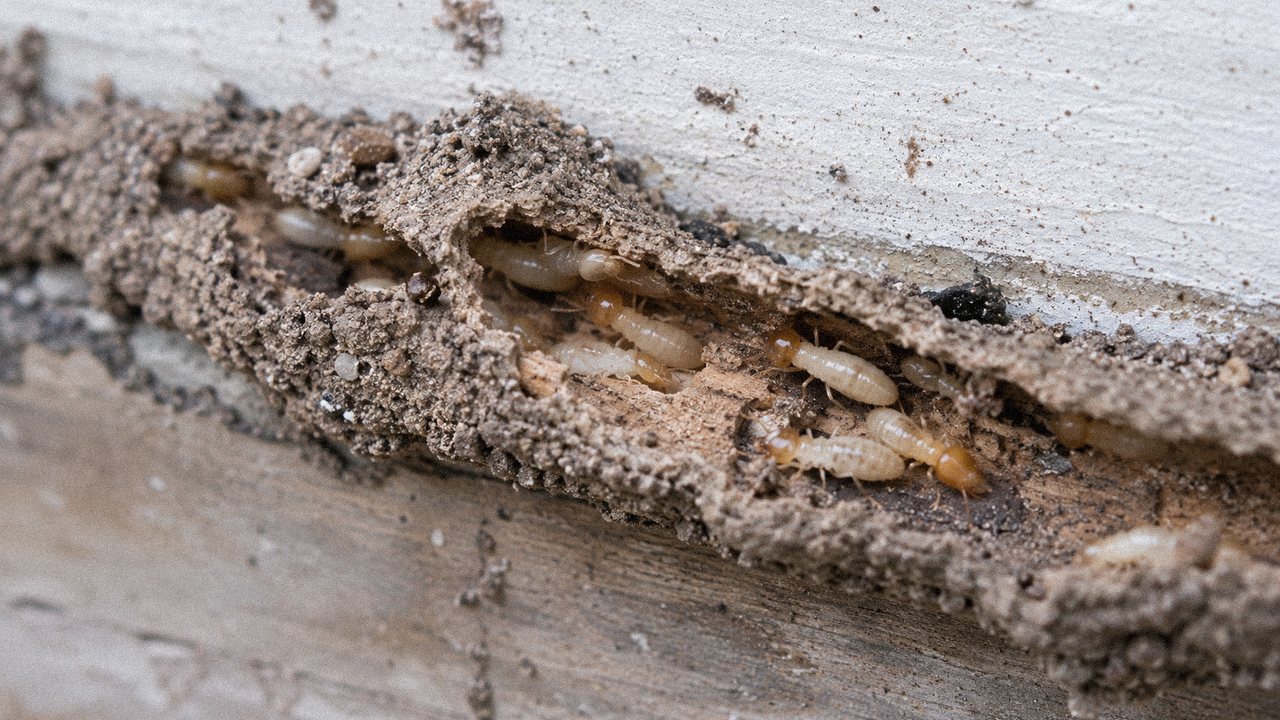
What Is the Eastern Subterranean Termite?
The eastern subterranean termite, Reticulitermes flavipes, is native to Florida and found statewide. Two close relatives, R. virginicus and R. hageni, live here too, and all three behave much the same around a house. According to UF/IFAS, a single R. flavipes colony may contain 100,000 to 1,000,000 termites and forage up to 150 feet for food.
Three habits explain almost every sign you will find:
- It needs moisture. The colony lives in the soil and workers travel to wood inside protective mud tubes so they do not dry out.
- It feeds year-round in Florida. There is no winter pause in the damage.
- It hides. Infestations often go unnoticed until remodeling, according to UF/IFAS, because the termites hollow out wood from the inside.
UF/IFAS also notes that subterranean termites account for about 80% of the roughly $20 billion spent each year in the U.S. on termite control and repairs, and that R. flavipes is one of the main species behind that share. For photos and a species profile, see our eastern subterranean termite page.
Sign 1: Daytime Swarms in Late Winter and Spring
A swarm is often the first sign homeowners notice. Swarmers, also called alates, are the winged males and females that leave a mature colony to start new ones. Eastern subterranean swarmers are dark brown to nearly black and about 0.4 inches long with their wings.
What makes this species distinctive is when it flies. UF/IFAS reports that R. flavipes and R. virginicus fly on warm, sunny, windless early afternoons, usually after rain, while R. hageni flies in the evening. South Florida populations may fly earlier in the season than those in North Florida.
Source: UF/IFAS EDIS (IN369)
A colony needs time before it swarms: UF/IFAS says a new colony may take 5 to 10 years to mature enough to produce alates. A swarm coming out of a wall, baseboard or slab joint therefore points to an established colony, not a new arrival. Our article on termite swarming in Florida explains what to do while a swarm is happening.
Need help with pests in South Florida?
Toro Pest Management has protected homes and businesses since 1969. Get a free inspection and $25 off your first service, backed by our 110% Satisfaction Guarantee: if the pests come back, so do we, at no extra cost.
Sign 2: Mud Tubes on the Foundation
Mud tubes, also called shelter tubes, are the most reliable sign of any subterranean termite. Eastern subterranean termites build them from the ground up, usually along the foundation, to travel between the soil and the wood they feed on. They look like flattened, muddy lines about the width of a pencil.
Virginia Tech’s extension service lists the places to check:
- Foundation walls and exposed slab edges
- Along cracks in concrete, expansion joints and slab cracks
- Around plumbing connections and utility conduits that pass through the slab
- Behind baseboards, under flooring and behind siding
- Where stucco or other cladding runs below the soil line
The Florida Department of Agriculture and Consumer Services adds that tubes can form between siding and the foundation, where termites enter without being seen. In South Florida’s block-and-stucco homes, the garage is often the easiest place to spot them because the slab edge and lower walls are exposed.
Sign 3: Discarded Wings Near Windows, Sinks and Tubs
After a swarm, termites shed their wings. Piles of small, equal-sized wings on windowsills, floors or caught in spider webs are a strong sign of infestation, according to Virginia Tech. Swarmers head toward light, so look near light fixtures, windows, doors and vents.
UF/IFAS adds a detail specific to native subterranean termites: dead alates indoors are often found near windows, sinks and bathtubs, usually with their wings still attached. Swarmers that emerge indoors cannot reach soil and dry out quickly, so they die where they land.
Sign 4: Hollow, Blistered or Soft Wood
Subterranean termites eat the softer springwood and leave the grain and outer surface intact, so damaged wood can look normal. Look and tap for:
- Hollow sounds. Tap wood every few inches with a screwdriver handle. A hollow sound, or a screwdriver that breaks through easily, suggests galleries inside.
- Blistered or peeling surfaces. UF/IFAS notes that severely damaged wood can look blistered or peeling, with a paper-thin surface.
- Dark areas or blisters in wood flooring, which Virginia Tech lists as a common sign.
- Soil in the damage. Subterranean termites carry soil into their feeding galleries, so broken wood with packed soil or mud inside points to them rather than to drywood termites.
- Live workers. Active galleries may contain worker termites, which confirms the infestation is current.
Wood damage is easy to confuse with rot. If you are not sure what you are looking at, read water damage vs. termite damage before you start pulling boards.
How to Tell Eastern Subterranean Termites From Formosan and Asian Termites
In Miami-Dade and Broward, a subterranean termite sign could belong to any of three species. Formosan and Asian subterranean termites (both in the genus Coptotermes) form much larger colonies and need a faster response, so the details matter.
| What you see | Eastern subterranean | Formosan subterranean | Asian subterranean |
|---|---|---|---|
| Swarmer color | Dark brown to nearly black | Orange to light amber-brown | Dark brown, two light spots on the head |
| Swarmer length with wings | About 0.4 in | About 0.5-0.6 in | About 0.5 in |
| Time of flight | Sunny early afternoon, often after rain | Shortly after sunset | Dusk or night |
| Season in Florida | About January-April | Early April to late June, peak in May | February-April |
| Soldier head | Rectangular | Teardrop-shaped | Teardrop-shaped |
| Colony size | 100,000 to 1,000,000 | Several million | Large, can cause severe damage quickly |
The simplest field clue is time of day. Dark swarmers in your kitchen at 1 p.m. after a rainy morning are most likely native subterranean termites. Swarmers around the porch light after dark are more likely Formosan or Asian termites, the species UF/IFAS warns can cause severe damage in a relatively short time.
Signs That Point to Something Else
Not every termite-like clue means eastern subterranean termites:
- Small, hard pellets piling up below wood point to drywood termites, which live inside the wood and never build mud tubes.
- Winged insects with pinched waists and bent antennae are ants. Many Florida ants swarm in the same months.
- Soft, dark, crumbly wood with no tunnels near a leak is more likely rot, though rot and termites often show up together, since moisture attracts both.
Our overview of subterranean termites and the hidden damage they cause compares all three subterranean species and their treatments in more depth.
What to Do When You Find Signs
Finding one of these signs is not an emergency, but it is a reason to act this week, not next season.
- Leave the evidence in place. Do not scrape off mud tubes or spray them. Spraying kills a few workers and does nothing to the colony in the soil.
- Document it. Take photos with a coin or tape measure for scale and note every location.
- Save samples. Put a few swarmers or wings in a sealed plastic bag for your inspector.
- Get the species identified. UF/IFAS stresses identifying termites before choosing a treatment.
- Use a licensed professional. UF/IFAS states that treatments for native subterranean termites must be applied by a licensed pest management provider.
Professional control relies on two approaches, according to UF/IFAS: non-repellent liquid termiticides, which block colonies from the structure, and baits, which eliminate colonies that feed on them.
At Toro, a termite control visit starts with a free inspection: a technician trained at the TORO Institute identifies the species and checks how far the damage goes. For eastern and other subterranean termites, Toro installs the Sentricon baiting system in the soil around the property, with no drilling into the slab and no trenches, and the stations stay in place for year-round protection against new colonies.
Once the colony is under control, the conditions that drew it in still matter. Our list of preventive measures against eastern subterranean termites covers moisture, mulch and wood contact, and if you plan to sell, see how these termites can affect your property value.

Contact Toro today
A free inspection & $25 off your first service
A trained Toro technician inspects your home or business, explains what was found and gives you a clear plan and quote, backed by our 110% Satisfaction Guarantee.
305-594-4767Frequently Asked Questions
What does an eastern subterranean termite look like?
Can you hear eastern subterranean termites in the walls?
Do eastern subterranean termites die in winter in Florida?
Are discarded wings always from termites?
How long does it take for eastern subterranean termites to swarm from a new colony?
Sources
- Native Subterranean Termites: Reticulitermes flavipes, R. virginicus, R. hageni (EDIS IN369), UF/IFAS Extension
- Signs of Subterranean Termite Infestation (Publication 444-501), Virginia Cooperative Extension, Virginia Tech
- Formosan Subterranean Termite, Coptotermes formosanus (EDIS IN278), UF/IFAS Extension
- Asian Subterranean Termite, Coptotermes gestroi (EDIS IN285), UF/IFAS Extension
- The Facts About Termites and Mulch (EDIS IN651), UF/IFAS Extension
- Protecting Yourself and Your Property Against Subterranean Termites, Florida Department of Agriculture and Consumer Services
Educational content. This article is for general information about pests in South Florida and is not medical, legal or professional advice. If you have a bite, sting or allergic reaction, contact your doctor; in an emergency, call 911. Pest problems vary from home to home, so a licensed professional should inspect before treatment. When using any pesticide, always read and follow the product label.


