
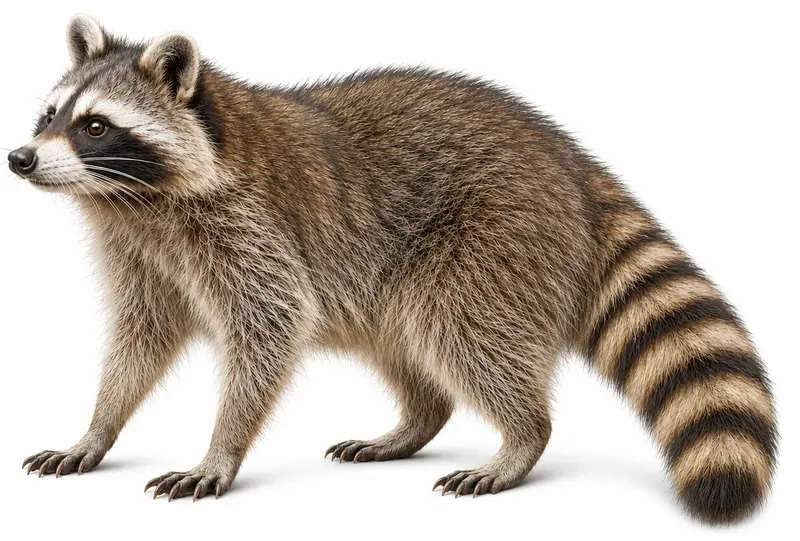
The northern raccoon (Procyon lotor) is a native Florida mammal that adapts easily to neighborhoods. In South Florida it raids garbage cans and pet food, moves into attics, crawl spaces and sheds to raise its young, and leaves droppings on roofs, decks and pool steps. The Florida Department of Health calls the raccoon the most important wildlife rabies host in the state, so a raccoon living in or around your home is a problem to handle with care.
- Since 1969Third generation, protecting South Florida
- 110% GuaranteeIf the bugs come back, so will Toro, at no additional cost
- Within 24 HoursResponse guaranteed
- Free InspectionPlus $25 off your first service
What Are Raccoons?
The northern raccoon, Procyon lotor, is a native mammal found throughout Florida, from the Panhandle to the Keys. It does well around people: parks, canals, golf courses and neighborhoods give it water, shelter and plenty of food. UF/IFAS notes that raccoon numbers can reach up to 100 per square mile where food is abundant, especially in coastal and wetland areas, which describes much of South Florida.
Raccoons are mostly active from evening through the night, but UF/IFAS points out that daytime foraging is not unusual and does not by itself mean an animal is sick. Each raccoon uses a home range of 1 to 3 square miles, so the same animal may visit several yards in one night.
Unlike green iguanas, raccoons are native wildlife. They can be trapped and removed when they become a nuisance, but the Florida Fish and Wildlife Conservation Commission (FWC) sets rules on how traps are used and where a captured raccoon may go.
How to Identify Raccoons
- Size: adults are about 2 to 3 feet long, including a tail of about 10 inches, and weigh 10 to 30 pounds. UF/IFAS notes that Florida raccoons tend to be smaller than those farther north.
- Face: a black “mask” across the eyes with white fur above the eyes and around the snout.
- Tail: thick and bushy, with alternating dark and light rings.
- Body and fur: a stout body with grizzled gray and black fur and a lighter belly.
- Paws: hand-like front paws that grab, pull and pry, which is how raccoons open garbage lids and tear back soffits and screens.
- Tracks and droppings: tracks look like small human handprints; droppings are tubular, dark and often left in piles in the same spot.
Raccoon Life Cycle and Behavior
Raccoons eat almost anything. UF/IFAS lists fruit, seeds, insects, crayfish, crabs, fish, frogs, eggs, small animals and carrion in the wild, and bird seed, pet food and garbage around homes. They take as much plant food as animal food over the year.
In Florida, raccoons have one litter a year, usually born in March and April, with an average of 3 to 4 young and up to 7. The young open their eyes at about 20 days, are weaned at 10 to 12 weeks and may stay with their mother until they are about 10 months old. A mother looking for a safe, dry place to raise her litter is the raccoon most likely to break into an attic.
In nature, raccoons den in hollow trees. In neighborhoods, UF/IFAS lists attics, crawl spaces, decks, sheds, culverts, storm drains and debris piles as common den sites. They get into attics through torn screens, soffits, open chimneys and gaps at the roofline.
Signs Raccoons Are Living on Your Property
- Heavy thumping, walking or scratching sounds in the attic or ceiling at dusk and during the night.
- Chirping, whimpering or chattering sounds in spring, a sign of a mother with young.
- A torn or pushed-in soffit, roof vent, ridge vent or attic screen, or damaged shingles at the roofline.
- Muddy paw prints on walls, gutters, downspouts or the edge of the roof.
- Piles of droppings in one spot on the roof, deck, attic floor, woodpile or pool steps.
- Garbage cans tipped over and trash scattered overnight, or pet food bowls emptied.
- Dug-up lawn patches and new plantings, or damaged fruit trees.

Contact Toro today
A free inspection & $25 off your first service
A trained Toro technician inspects your home or business, explains what was found and gives you a clear plan and quote, backed by our 110% Satisfaction Guarantee.
305-594-4767Why Raccoons Are a Problem
Damage to your home. A raccoon can rip open soffits, vents and screens to get inside, then tear up and soil the attic insulation, and damage ductwork and wiring covers. The longer it stays, the more damage and cleanup there is.
Rabies. The Florida Department of Health calls the raccoon the most important wildlife rabies host in Florida and notes that raccoons can shed the virus in their saliva without showing symptoms. UF/IFAS adds that rabies is uncommon in wild raccoons, but the risk is serious enough that you should never touch, corner or feed one, and you should keep pets’ rabies vaccinations up to date.
Raccoon roundworm. The CDC explains that raccoons can carry Baylisascaris procyonis, a roundworm whose eggs pass in their droppings. Infections in people are rare but can be severe, and the eggs can stay infective in soil and debris for years. That makes raccoon latrines on decks, roofs, attics and around pools a real health concern, especially for small children and pets.
Pools and patios. UF/IFAS notes that raccoons often defecate in swimming pools, usually on the steps.
Pets, poultry and gardens. Raccoons eat pet food left outside, raid bird feeders, and can kill backyard chickens and other small animals. They also dig up lawns and new plantings looking for food.
Where Raccoons Live and Hide on South Florida Properties
- Attics, reached through soffits, roof vents, gable vents and gaps at the roofline.
- Crawl spaces and the space under decks, porches and sheds.
- Chimneys without a cap.
- Storm drains, culverts and canal banks, which they travel along at night.
- Trees, especially large trees with branches over the roof, that give easy access to the roofline.
- Common areas of condos, HOAs, golf courses, marinas, restaurants and hotels where garbage and dumpsters are easy to reach.
When Raccoons Are Most Active in South Florida
| Season | Raccoon activity | What to do |
|---|---|---|
| Late winter | Pregnant females look for safe, dry den sites, including attics and crawl spaces | Inspect soffits, vents and the roofline, and repair openings before a raccoon moves in. |
| March to April | Most litters are born in Florida; mothers stay close to their young | Act quickly if you hear sounds in the attic, and do not seal an opening while young may be inside. |
| Summer | Young raccoons start following their mother on nightly trips for food | Secure garbage, bring pet food in before dark and cover pool steps at night. |
| Year-round | Raccoons are active all year in South Florida, mostly from dusk through the night | Never feed raccoons and keep trees trimmed back from the roof. |
How to Keep Raccoons Away
These steps follow UF/IFAS and FWC guidance.
- Never feed raccoons. UF/IFAS warns that feeding leads to more raccoons and bolder raccoons near homes, and Florida rules prohibit feeding raccoons in a way that creates a public nuisance.
- Lock up the garbage. Use raccoon-proof cans, weigh down or strap the lids, or keep cans in the garage or a latched bin until pickup day.
- Bring pet food in. Feed pets during the day and remove bowls before dusk.
- Clean up food sources. Pick up fallen fruit, take down bird feeders or clean up spilled seed, and protect backyard chickens in a covered, closed coop at night.
- Seal the house, but only when it is empty. Repair torn soffits and screens, screen vents, cap the chimney and close gaps under decks and sheds once you are sure no animals or young are inside.
- Trim trees so branches do not reach the roof.
- Do not handle droppings dry. Wear gloves, avoid stirring up dust and keep children and pets away. Call a professional for attic latrines.
How Toro Handles Raccoon Problems
- Property inspectionA Toro technician inspects your attic, roofline, soffits, vents, crawl space and yard to find how raccoons are getting in, where they are denning and what is drawing them to your property.
- Humane trapping and removalThrough our wildlife control service, we set humane live traps, check them at least every 24 hours and handle each captured raccoon following FWC rules.
- Advice on closing the entry pointsOnce the animals are out, we show you the openings that need to be repaired and the changes that make your property less inviting, from garbage to tree branches.
- Follow-upWe come back to check the traps and the property until the raccoons are gone, and tell you what to watch for so new ones do not move in.
Toro Pest Management has served South Florida since 1969. Our wildlife trapping and removal serves Miami-Dade properties, from Miami and Miami Beach to Doral, Hialeah, Pinecrest and Homestead; elsewhere, call to check. We also work with property managers, restaurants and food businesses and hotels and resorts on garbage areas and common grounds. We respond within 24 hours, guaranteed, and offer a free inspection plus $25 off your first service. Call 305-594-4767. Hablamos Español.
Seeing signs of raccoons? Get a free inspection and $25 off your first service.
Schedule Your Free InspectionRaccoons: Frequently Asked Questions
How do I know if I have a raccoon in my attic?
The most common signs are heavy thumping or walking sounds in the ceiling at dusk and during the night, chirping or chattering sounds in spring when there are babies, a torn soffit, roof vent or screen, muddy paw prints on the walls or roof edge, and droppings piled in one spot. Raccoons are much heavier than rats, so the noise is louder and slower.
Is it legal to trap and remove raccoons in Florida?
Yes, when it follows Florida Fish and Wildlife Conservation Commission (FWC) rules. Property owners may take nuisance wildlife on their own property or authorize someone to do it. Live traps must be checked at least once every 24 hours, and a captured animal must be released legally or humanely euthanized within 24 hours. The FWC allows release on the same property, or relocation only to a site of at least 40 contiguous acres in the same county with the landowner's written permission. Many homeowners hire a wildlife control professional.
Do raccoons carry rabies in Florida?
They can. The Florida Department of Health calls the raccoon the most important wildlife rabies host in Florida and notes that a raccoon can shed the virus in its saliva without showing signs of illness. UF/IFAS adds that rabies is uncommon in wild raccoons and that a raccoon out during the day is not necessarily rabid. Never touch or feed a raccoon. If a person is bitten or scratched, wash the wound with soap and water, see a doctor right away and report it to your county health department.
Are raccoon droppings dangerous?
They can be. The CDC explains that raccoon droppings can contain the eggs of raccoon roundworm (Baylisascaris procyonis), a parasite that is rare in people but can cause serious illness if the eggs are swallowed, and that the eggs can survive in soil and debris for years. Raccoons tend to use the same spots, called latrines, on roofs, decks, attics and woodpiles. Do not sweep or vacuum droppings dry, and keep children and pets away from them.
Why are raccoons pooping in my pool?
Pool steps are a common raccoon latrine. UF/IFAS notes that raccoons often defecate in swimming pools, usually on the steps, and suggests covering the top steps with a plastic sheet or panels at night. Because of the roundworm risk, remove droppings carefully with gloves and follow your pool professional's advice before swimming again.
Will a raccoon leave my attic on its own?
Sometimes, but a mother with young will usually stay until the babies can follow her, which takes weeks. If you seal the entry while young are inside, the mother can tear new holes to get back in. That is why the animals should be removed before the openings are repaired, and why spring is the season to act quickly.
How do I keep raccoons away from my house?
UF/IFAS recommends removing what attracts them: use raccoon-proof garbage cans or keep them in the garage, feed pets during the day and bring the bowls in before dark, take down or clean up under bird feeders, pick up fallen fruit, and never feed raccoons. Seal or screen openings at the roofline, soffits, vents and crawl spaces once no animals are inside.
Related Pests
Pest Control Across South Florida
Toro treats raccoons in homes and businesses throughout Miami-Dade, Broward and Palm Beach counties, including:
- Miami
- Hialeah
- Doral
- Miami Beach
- Coral Gables
- Homestead
- Fort Lauderdale
- Hollywood
- Pembroke Pines
- Miramar
- Boca Raton
- West Palm Beach
Last updated: November 1, 2026

110% Satisfaction Guaranteed
If the bugs come back, so will TORO, at no additional cost to you. TORO responds within 24 hours, guaranteed, and our technician will arrive quickly and deal with the pest problem to prevent it from coming back.
- Free return visits
- 24-hour response
- Trained, licensed technicians

