Key takeaways
- Asian subterranean termites are established from the Keys to Palm Beach County and, according to a 2026 University of Florida study, as far north as Brevard and Hillsborough counties; they can cause severe damage in a relatively short time (UF/IFAS).
- They swarm from February to April at dusk or at night, and lights draw the swarmers to homes, so screens and closed doors matter.
- Moisture is the biggest invitation: roof leaks, AC condensate and sprinklers that wet walls help colonies settle in.
- In Florida they have been found in buildings, ornamental trees near buildings and boats, so check all three.
- Prevention lowers the risk but does not replace inspections and professional bait or soil protection.
In this article
- Why Asian Subterranean Termites Need Their Own Prevention Plan
- Step 1: Cut Off the Moisture Termites Depend On
- Step 2: Break Wood-to-Soil Contact and Keep the Foundation Visible
- Step 3: Turn Down the Lights During Swarm Season
- Step 4: Check Trees, Stumps and Old Roots Near the House
- Step 5: Watch Your Boat and Dock if You Live on the Water
- Step 6: Seal Cracks and Close Hidden Entry Points
- Step 7: Schedule Inspections and Professional Protection
- Your Asian Subterranean Termite Prevention Checklist
- Frequently Asked Questions
The best way to prevent Asian subterranean termites is to take away what a colony needs to settle near your home: moisture, wood it can reach from the soil and hidden routes into the structure. Add a few habits during swarm season and regular professional inspections, and you greatly reduce the chance that a colony gets established before anyone notices.
This matters more in South Florida than almost anywhere in the country. The Asian subterranean termite (Coptotermes gestroi) is a tropical invader that UF/IFAS warns can cause severe damage in a relatively short time once a large, mature colony moves into a building. The steps below are tailored to how this species lives and spreads here.
Why Asian Subterranean Termites Need Their Own Prevention Plan
Most termite advice is written for native termites that live in the soil and build mud tubes up the foundation. The Asian subterranean termite does that too, but it has a few habits that change where you should look:
- It lives in a small, warm corner of the US. According to UF/IFAS, it was first found in the continental United States in Miami in 1996, then in Key West, and by 2005 in Fort Lauderdale and Riviera Beach. UF/IFAS has described its range as limited to tropical areas up to about 26 degrees north, which makes southern Florida its home turf, but a 2026 University of Florida study found it established as far north as Brevard and Hillsborough counties.
- It travels by boat. UF/IFAS has documented infested boats in Florida and names shipboard infestations as the most likely way people spread it.
- It shares the area with the Formosan termite. Broward and Miami-Dade were the first counties where it and the Formosan subterranean termite were documented established together. Both build carton nests in wall voids and hollow trees.
- It is found around buildings, trees and boats. In Florida, the species has been collected only from structures, ornamental trees near structures and boats.
So a good prevention plan covers the house, the yard and, if you have one, the boat.
Step 1: Cut Off the Moisture Termites Depend On
Subterranean termites need moisture to survive. A new colony starts in a crack or crevice with enough moisture, as UF/IFAS describes for the Formosan termite, and Coptotermes colonies can fill structural voids with carton once they are established. Every steady source of water in or against your house is an invitation.
Fix these first:
- Roof and window leaks, especially after storms. Water that soaks into sheathing, trusses or wall framing gives termites a moist place to work above the ground.
- AC condensate lines that drip against the foundation or into a wall cavity.
- Plumbing leaks under sinks, behind tubs and in garage walls.
- Sprinklers that wet the walls. UF/IFAS points out that the Florida building code requires irrigation to be at least 1 foot from a building sidewall, and that sprinklers watering the walls are a conducive condition that can void termite warranties.
- Poor drainage. Gutters and downspout extensions carry roof water away. As FDACS puts it, your house should not sit in a bowl; it should sit on one.
Need help with pests in South Florida?
Toro Pest Management has protected homes and businesses since 1969. Get a free inspection and $25 off your first service, backed by our 110% Satisfaction Guarantee: if the pests come back, so do we, at no extra cost.
Step 2: Break Wood-to-Soil Contact and Keep the Foundation Visible
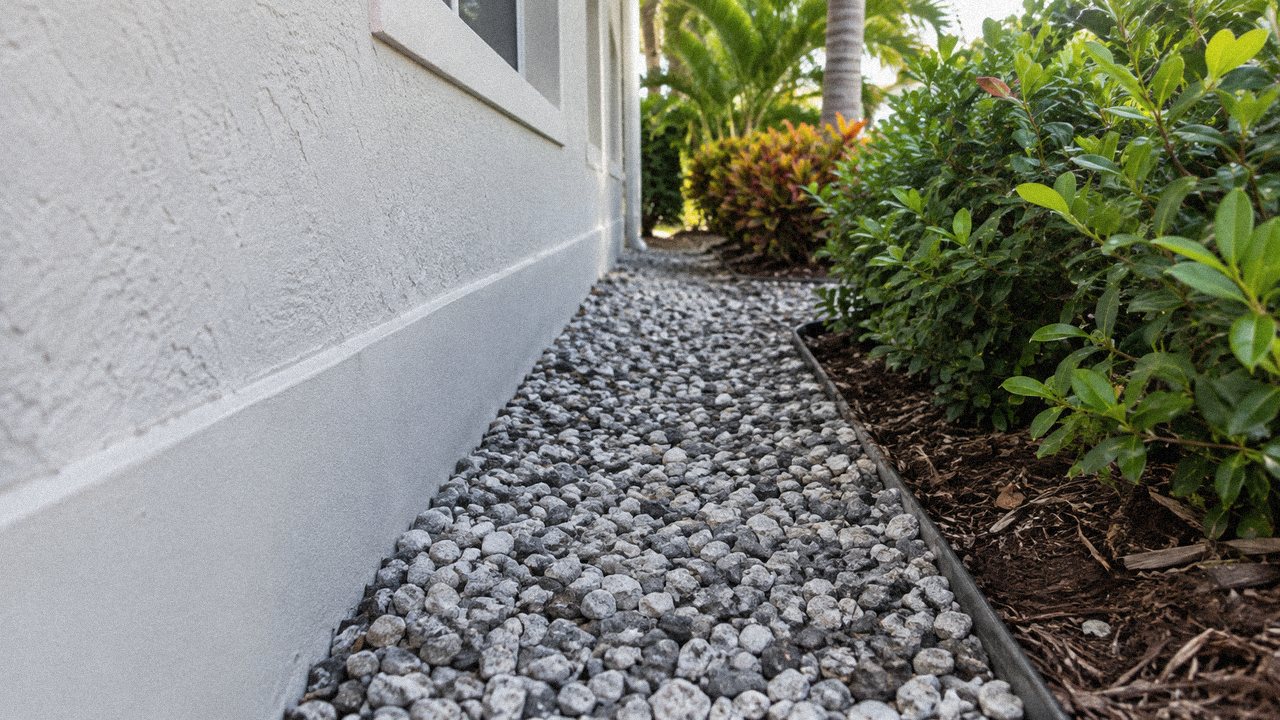
Wood touching the soil is a direct bridge from the colony into your home, and a foundation hidden by mulch or plants lets termites build their tubes unseen. The fixes are simple and mostly free.
| Around the foundation | What to do | Why it helps |
|---|---|---|
| Mulch | Keep it under 2 inches thick within 12 inches of the foundation (UF/IFAS) | Soil dries and tubes stay visible |
| Inspection strip | Leave about 6 inches of exposed foundation | You or your inspector can spot mud tubes |
| Foam board and stucco | Stop them 6 to 8 inches above the soil (FDACS) | Termites cannot tunnel up behind them unseen |
| Soil grade | Slope the yard so water drains away from the walls | Keeps the soil next to the slab dry |
| Wood in contact with soil | Remove form boards, stakes, lumber and firewood near the house | Removes food and bridges into the structure |
| Fences, steps and deck posts | Keep untreated wood off the ground or use treated wood | Fewer hidden connections to the home |
Our guide to how landscaping choices attract termites walks through the yard in more detail.
Step 3: Turn Down the Lights During Swarm Season
Every year, mature colonies release swarms of winged termites (alates) to start new colonies. UF/IFAS has recorded Asian subterranean termite flights in Florida from February to April, at dusk or at night, with large numbers of alates leaving the colony at once. The season ends about when Formosan termites start to swarm, so South Florida has winged Coptotermes in the air from late winter well into early summer.
active peak
Source: UF/IFAS EDIS (IN285, IN278)
Swarmers fly toward light. UF/IFAS lists porch lights, indoor lights and even video monitors as attractions that bring alates indoors, especially through open doors and unscreened windows. Most of the ones that get inside die quickly from drying out, but swarmers that land outdoors near moist wood or soil can pair off and start new colonies.
During these months:
- Keep doors closed and screens in good repair in the evening.
- Switch off porch and pool lights you do not need after dark, or use yellow bulbs.
- Close blinds on lit rooms facing the yard.
- Sweep up wings and dead swarmers, but first save a few in a sealed bag for identification.
Hundreds to thousands of swarmers inside the house usually mean a structural infestation, not visitors from outside (UF/IFAS). If you see that, call for an inspection right away.
Step 4: Check Trees, Stumps and Old Roots Near the House
Coptotermes termites do not limit themselves to buildings. UF/IFAS reports that Formosan termites hollow out living trees by eating the dead wood at the center, and the Asian species has been collected from ornamental trees near structures in Florida. A colony in a tree beside your house can forage into the home, and a hollowed tree is more likely to fail in high winds.
- Remove dead trees, stumps and buried roots near the foundation when practical.
- Keep branches and vines from touching the roof and walls.
- Have trees within reach of the house checked during termite inspections; UF/IFAS recommends inspecting surrounding trees regularly.
- Be cautious with salvaged timbers, old railroad ties and used lumber in landscaping, which can carry termites to a new yard.
Step 5: Watch Your Boat and Dock if You Live on the Water
Waterfront homes have an extra pathway. UF/IFAS has documented Asian subterranean termites infesting boats in Key West and private boats arriving in Fort Pierce, Hollywood and Fort Lauderdale from the Caribbean. In 2025, UF/IFAS researchers described Fort Lauderdale as a known hotspot for introductions via recreational boats, and private vessels as a major pathway for spreading these termites.
If you own a boat:
- Look for mud tubes, soft or hollow wood and carton material in cabins, lockers and wooden trim.
- Keep the boat dry; fix deck and hatch leaks.
- Treat winged termites seen aboard, especially at night in the spring, as a reason to call a professional.
- Keep docks, seawall caps and boathouse wood dry and visible where possible.
Step 6: Seal Cracks and Close Hidden Entry Points
Sealing helps, but it is not a termite barrier on its own. Hairline cracks in a slab are normal, while large settlement cracks give subterranean termites a way in, according to FDACS. Fixing them properly may involve a professional treatment through drilled holes before the crack is sealed.
- Have large slab and wall cracks evaluated during an inspection.
- Caulk gaps around pipes, conduits and AC lines where they enter the house.
- Keep crawl space and attic vents screened and in good repair.
- Check the garage, where slab joints, stored boxes and water heaters often hide the first signs.
Step 7: Schedule Inspections and Professional Protection
Even with perfect habits, a colony can find a crack you cannot see. That is why UF/IFAS stresses frequent inspections or preventive treatments in areas with a high density of the closely related Formosan termite, and the same logic applies where Asian subterranean termites are established. A trained inspector checks the foundation, garage, attic, trees and moisture problems, and can spot early activity long before the damage shows. Read more about why regular inspections matter for Asian subterranean termites.
UF/IFAS recommends the same control strategies for this species as for the Formosan termite: termite baits and soil treatments. The options, and how they compare, are covered in our guide to preventive treatments for Asian subterranean termites.
At Toro, termite control starts with a free inspection: a trained technician identifies the species and checks how far any activity goes. For subterranean termites, Toro installs the Sentricon baiting system in the soil around the property, with no drilling into the slab and no trenches, and the stations stay in place for year-round protection against new colonies. Toro has protected South Florida homes since 1969, and the work is backed by the 110% Satisfaction Guarantee.
Your Asian Subterranean Termite Prevention Checklist
Use this list at the start of each year, before the February swarm season:
- Repair roof, plumbing and window leaks, and reroute AC condensate away from the house.
- Aim sprinklers at least 1 foot from the walls and clean the gutters.
- Thin the mulch near the foundation and keep a 6-inch inspection strip clear.
- Remove wood, stumps and debris touching the soil near the house.
- From February to April, keep doors closed, screens repaired and outdoor lights off at night.
- Check trees, boats and docks along with the house.
- Book a professional termite inspection and keep your termite protection active.
If you already see mud tubes, wings or soft wood, get an inspection before the damage spreads. To understand why this species worries researchers so much, read about the most invasive termite in South Florida.
Contact Toro today
A free inspection & $25 off your first service
A trained Toro technician inspects your home or business, explains what was found and gives you a clear plan and quote, backed by our 110% Satisfaction Guarantee.
305-594-4767Frequently Asked Questions
Can I make my house completely termite-proof?
Do Asian subterranean termites live in palm trees and other yard trees?
What time of year should I watch for Asian subterranean termites?
Is a concrete block house safe from Asian subterranean termites?
Should I treat the soil myself with a store-bought termite product?
Sources
- Asian Subterranean Termite, Coptotermes gestroi (EDIS IN285), UF/IFAS Extension
- Formosan Subterranean Termite, Coptotermes formosanus (EDIS IN278), UF/IFAS Extension
- The Facts About Termites and Mulch (EDIS IN651), UF/IFAS Extension
- Protecting Yourself and Your Property Against Subterranean Termites, Florida Department of Agriculture and Consumer Services
- UF/IFAS Scientists Confirm Hybrid Termites Established in Florida, UF/IFAS News
- New Study Shows Invasive Termites Threatening Homes in Florida Are Spreading Farther Than Predicted, University of Florida News
Educational content. This article is for general information about pests in South Florida and is not medical, legal or professional advice. If you have a bite, sting or allergic reaction, contact your doctor; in an emergency, call 911. Pest problems vary from home to home, so a licensed professional should inspect before treatment. When using any pesticide, always read and follow the product label.


