
Key takeaways
- UF/IFAS recommends the same strategies for Asian subterranean termites as for Formosan termites: baits and soil treatments.
- Bait systems aim to eliminate the colony; liquid termiticides keep termites out of a treated zone but may not eliminate colonies nearby.
- In UF/IFAS research, fewer than 5% of a colony had to feed on a bait for the colony to be eliminated within about 90 days.
- Physical barriers such as steel mesh or sized sand, and borate wood treatments, are mainly built in during construction.
- Over-the-counter products are unlikely to work; termiticide treatments are a job for a licensed professional.
In this article
- Why Asian Subterranean Termites Call for Preventive Treatment
- Termite Bait Systems: Eliminating the Colony
- Liquid Soil Termiticides: Keeping Termites Out
- Physical Barriers and Wood Treatments
- Preventive Treatments Compared
- Why DIY Products Will Not Prevent Asian Subterranean Termites
- Prevention Works Best With Good Habits
- How Toro Protects Homes From Asian Subterranean Termites
- Frequently Asked Questions
The main preventive treatments for Asian subterranean termites are termite bait systems and liquid soil termiticides, supported by physical barriers and wood treatments when a building is under construction. UF/IFAS recommends the same strategies for this species as for the Formosan termite: baits and soil treatments, applied by professionals.
Choosing between them comes down to what each one actually does. Baits are designed to eliminate the colony that feeds on them, while liquid barriers keep termites out of a treated zone around your home. This guide compares the options, explains why the Asian subterranean termite calls for preventive protection in South Florida, and shows what to expect from a professional plan.
Why Asian Subterranean Termites Call for Preventive Treatment
The Asian subterranean termite (Coptotermes gestroi) is an invasive tropical species established from the Keys to Palm Beach County, and a 2026 University of Florida study found it as far north as Brevard and Hillsborough counties. UF/IFAS warns that its damage can become severe in a relatively short time once a large, mature colony invades a structure, and that infestations in Florida are becoming more common.
Three things make waiting for signs a risky strategy:
- Swarms every spring. From February to April, mature colonies release large flights at dusk and at night, so new colonies start near homes every year.
- Hidden feeding. Early signs are limited to swarms, foraging tubes and damage; by the time carton fills a wall void, the infestation is advanced.
- Shared territory. Broward and Miami-Dade also have the Formosan termite, a close relative with colonies of several million.
Preventive treatment means the colony meets protection before it reaches your framing. For why this species is so stubborn once it is inside, see why Asian subterranean termites are harder to control.
Termite Bait Systems: Eliminating the Colony
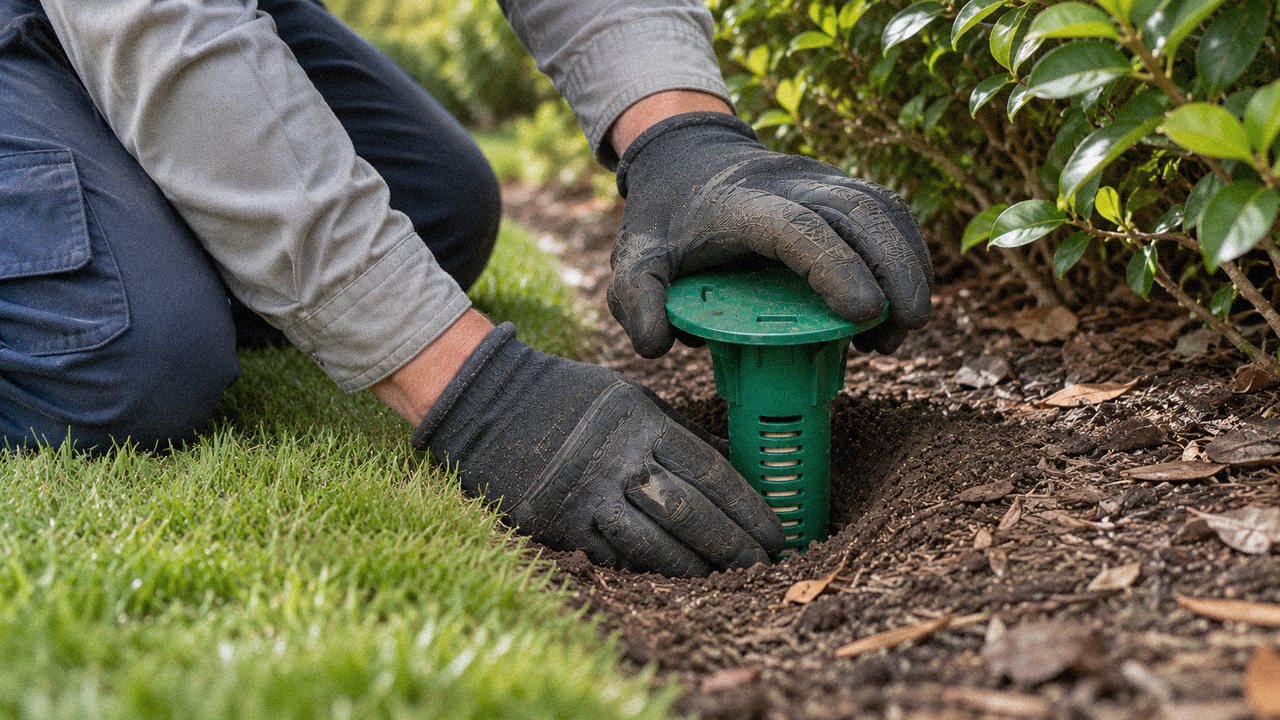
Bait systems use stations placed in the soil around the structure. Each station holds cellulose bait with a slow-acting insecticide. Foraging workers find the bait, feed on it and share it with the rest of the colony.
The baits used against subterranean termites are chitin-synthesis inhibitors (CSIs). Termites need to molt to grow, and these baits stop the molting process, so the colony dies as workers fail to molt. According to the EPA, active ingredients in termite baits include diflubenzuron, hexaflumuron and noviflumuron.
UF/IFAS research shows how little feeding it takes. In a study with 1.68 million termites, fewer than 5% of a colony’s termites needed to feed on bait, for a short time, for the colony to be eliminated within about 90 days. Termites may still show up in stations for up to three months, but the colony is already dying.
Baits are especially useful against Coptotermes termites because they can go where the colony is:
- In-ground stations around the perimeter intercept foraging termites in the soil.
- Above-ground stations can be placed directly on active foraging sites inside structures and in trees, as UF/IFAS describes for Formosan termites.
- Monitoring is built in: FDACS notes that stations must be checked periodically for termite activity.
The trade-off is time: baits work over weeks to months, not overnight, and they depend on regular service. Our article on how often termite bait stations should be checked explains what that service involves.
Need help with pests in South Florida?
Toro Pest Management has protected homes and businesses since 1969. Get a free inspection and $25 off your first service, backed by our 110% Satisfaction Guarantee: if the pests come back, so do we, at no extra cost.
Liquid Soil Termiticides: Keeping Termites Out
Liquid termiticides are applied to the soil around and under a building. Before construction, they are applied to the soil where the slab will go. After construction, they are applied by trenching along the foundation and by drilling or injecting through slabs and into voids, according to UF/IFAS.
UF/IFAS describes non-repellent liquid termiticides, which termites do not avoid, as forming a barrier that stops colonies from reaching the structure. The EPA lists bifenthrin, fipronil, imidacloprid and permethrin among common active ingredients in soil termiticides.
The key limitation, in UF/IFAS’s words, is that it is unlikely that termite colony activity in the surrounding area will be eliminated. A liquid treatment protects the structure from the outside in. FDACS adds that a pre-construction soil barrier does not eliminate a colony that may already exist in the soil beneath a home, and that moisture problems and construction work can break down a chemical barrier. For a deeper look at soil treatments, read all you need to know about termite ground treatment.
Physical Barriers and Wood Treatments
These options are mostly built into a home during construction or major renovation.
- Physical barriers: the EPA notes that steel mesh and sands of particular sizes have worked as termite barriers. They are usually installed during construction.
- Direct wood treatment: FDACS describes treating the bottom third of the wood framing with termiticide before insulation and drywall go in.
- Borates: the EPA notes that borate wood treatments are commonly sprayed on wood during new home construction.
- Treated building materials: some building materials are impregnated with termiticides.
None of these is a complete answer on its own. UF/IFAS cautions that there is no guarantee of permanent protection from termite damage with wood treatment, so these methods work best as one layer alongside baits or soil treatment and regular inspections.
Preventive Treatments Compared
| Treatment | How it works | Best suited for | Limitations |
|---|---|---|---|
| In-ground bait system | Workers share a CSI bait; colony fails to molt and dies | Existing homes; colonies near the structure | Takes weeks to months; needs regular monitoring |
| Above-ground bait station | Bait placed on active tubes or in trees | Active infestations inside walls or trees | Used once activity is found |
| Liquid soil termiticide | Treated soil zone that termites pick up as they pass | New slabs and post-construction barriers | May not eliminate nearby colonies; can be disturbed |
| Physical barrier | Steel mesh or sized sand at the foundation | New construction | Usually installed during construction |
| Borate or direct wood treatment | Treated wood resists feeding | New construction and renovations | No guarantee of permanent protection |
Why DIY Products Will Not Prevent Asian Subterranean Termites
Store-bought sprays and granules kill the termites they touch and miss the colony. UF/IFAS says control of the Formosan termite requires professional pest control services because over-the-counter products are unlikely to be effective, and it recommends the same professional baits and soil treatments for the Asian species. The EPA adds that termiticide application can, in most cases, only be done properly by a trained professional. Our article on why DIY termite treatments fail explains the risks.
Prevention Works Best With Good Habits
Treatment and maintenance work together. FDACS warns that leaks and construction problems left unrepaired can let termites through and cause treatments to fail. Fix moisture problems, keep mulch thin and wood off the soil, and keep the foundation visible. Our step-by-step guide on how to prevent Asian subterranean termites from infesting your home covers the homeowner side.
Read your termite contract, too. Florida warranties can cover retreatment only, retreatment and repair, or spot treatment with no warranty, and none of them replaces your homeowners policy. See is termite damage covered by homeowner’s insurance before you rely on either.
How Toro Protects Homes From Asian Subterranean Termites
Toro’s termite control service starts with a free inspection: a trained technician identifies the termite species and checks for activity and conducive conditions around the property. For subterranean termites, including the Asian subterranean termite, Toro installs the Sentricon baiting system:
- Bait stations go into the soil around your home, with no drilling into the slab and no trenches.
- Termites feed on the bait and carry it back to the colony, which is designed to eliminate the colony, including the queen.
- The stations stay in place for year-round protection against new colonies.
- Installation and service are handled by technicians trained in termite baiting at the TORO Institute, with Toro’s on-staff entomologists.
Toro offers termite prevention for homes that are not infested yet, as well as treatment for active infestations, across Miami-Dade, Broward, Palm Beach and the Keys. If the termites come back, so will Toro, at no additional cost to you.

Contact Toro today
A free inspection & $25 off your first service
A trained Toro technician inspects your home or business, explains what was found and gives you a clear plan and quote, backed by our 110% Satisfaction Guarantee.
305-594-4767Frequently Asked Questions
How long does a termite bait system take to eliminate a colony?
Do I need to drill into my slab for termite prevention?
How long does preventive termite treatment last?
Can a termite bait station attract termites to my house?
Are termite treatments safe for pets and children?
Sources
- Asian Subterranean Termite, Coptotermes gestroi (EDIS IN285), UF/IFAS Extension
- Formosan Subterranean Termite, Coptotermes formosanus (EDIS IN278), UF/IFAS Extension
- Termites: How to Identify and Control Them, US Environmental Protection Agency
- Using 1.68M Termites, UF/IFAS Students Show How Only a Few Need to Feed on Baits to Eliminate the Colony, UF/IFAS News
- Protecting Yourself and Your Property Against Subterranean Termites, Florida Department of Agriculture and Consumer Services
- New Study Shows Invasive Termites Threatening Homes in Florida Are Spreading Farther Than Predicted, University of Florida News
Educational content. This article is for general information about pests in South Florida and is not medical, legal or professional advice. If you have a bite, sting or allergic reaction, contact your doctor; in an emergency, call 911. Pest problems vary from home to home, so a licensed professional should inspect before treatment. When using any pesticide, always read and follow the product label.


